W3webschool Blog

Digital Marketing Course Syllabus (2026): Complete Modules, AI Tools & Career Skills

Planning to learn digital marketing but unsure what you'll actually study? This complete guide explains the latest Digital Marketing Course Syllabus (2026), including every module, AI tools, live projects, practical assignments, certifications and job-ready skills that leading institutes teach. Whether you're a student, fresher, working professional or business owner, this guide will help you understand what to expect before enrolling in a digital marketing course.

Updated for 2026
Reviewed by Industry Experts
12 Min Read
Beginner Friendly

18+ Industry Modules

Learn SEO, Google Ads, Meta Ads, AI Marketing, Analytics, Email Marketing, Content Marketing and more.

40+ Industry Tools

Explore hands-on tools including Google Analytics 4, Search Console, ChatGPT, Gemini, Canva, WordPress and modern platforms.

Live Projects & Portfolio

Understand how practical assignments and real-world projects help you build confidence and prepare for job interviews.

Career-Ready Skills

See how each module contributes to roles such as SEO Executive, Performance Marketer, Digital Marketing Executive and Freelancer.

A digital marketing course is much more than learning how to run advertisements or post on social media. Today's employers expect professionals who can plan marketing strategies, optimise websites for search engines, analyse campaign performance, create high-quality content and use AI tools to improve productivity.

That's why the Digital Marketing Course Syllabus (2026) has evolved significantly. Modern training now combines marketing fundamentals with practical projects, industry-standard tools and AI-assisted workflows to prepare students for real business challenges.

In this guide, you'll explore every module, industry tools, live projects, practical skills, career opportunities and AI topics included in a modern Digital Marketing Course Syllabus. Whether you're comparing institutes or planning your first marketing career, this guide will help you understand what to expect before joining a course.

Whether you're comparing institutes, planning your first digital marketing course or upgrading your skills, this guide will help you evaluate a syllabus based on practical learning rather than marketing claims.

What You'll Learn in This Guide

  • Complete Digital Marketing Course Syllabus (2026)
  • Detailed module-by-module explanation
  • Latest AI tools included in modern courses
  • Industry-standard software used by agencies
  • Live projects and hands-on assignments
  • Career opportunities after completing modules
  • Certifications that add value to your resume
  • Tips to choose the right course syllabus

What Is a Digital Marketing Course Syllabus?

Before enrolling in any digital marketing course, it's important to understand what the syllabus actually includes. A well-designed syllabus is more than just a list of topics—it acts as a learning roadmap that helps students develop practical skills, master industry tools and prepare for real-world marketing roles.

Today, digital marketing has evolved far beyond basic SEO and social media posting. Businesses expect professionals who can work with AI-powered tools, analyse marketing data, create high-converting campaigns and manage multiple digital channels. As a result, modern digital marketing courses have expanded their curriculum to include practical assignments, live projects, automation tools and industry certifications.

Whether you're a student planning your first career, a working professional looking to switch industries or a business owner wanting to grow online, understanding the syllabus helps you evaluate whether a course is worth your time and investment.

Why Is the Syllabus Important?

Many institutes advertise attractive placement offers or affordable course fees, but the syllabus is what determines the actual quality of your learning experience.

A comprehensive digital marketing syllabus should help you:

  • Build a strong foundation in digital marketing concepts.
  • Learn industry-standard tools used by agencies and top companies.
  • Work on practical assignments instead of relying only on theoretical concepts.
  • Develop essential analytical and problem-solving skills.
  • Create a professional portfolio through live client projects.
  • Prepare for job interviews and real client campaign management.
  • Stay updated with AI-powered marketing techniques and latest industry trends.

The right syllabus ensures that you graduate with skills employers are actively looking for, rather than outdated theoretical knowledge.

What Makes a Modern Digital Marketing Syllabus Different?

The digital marketing industry changes rapidly. Search engines, advertising platforms, AI technologies and consumer behavior continue to evolve every year. Because of this, the syllabus followed five years ago is no longer enough for today's competitive job market.

Traditional Syllabus
Modern 2026 Syllabus
Basic SEO
Advanced SEO + Technical SEO + Local SEO
Facebook Marketing
Meta Ads + Instagram Marketing + Audience Targeting
Blog Writing
SEO Content + AI-Assisted Content Strategy
Google Analytics
Google Analytics 4 (GA4) + Looker Studio
Manual Research
AI Research using ChatGPT, Gemini & NotebookLM
Theory Classes
Live Projects, Case Studies & Portfolio Development

This shift reflects how companies now hire digital marketers. Employers increasingly value candidates who can solve real business problems using practical skills and modern marketing software.

Who Should Learn This Syllabus?

This comprehensive curriculum is carefully designed for:

  • Students planning a successful career in digital marketing.
  • Fresh graduates looking for job-oriented practical skills.
  • Working professionals interested in a high-growth career switch.
  • Freelancers aiming to offer professional digital marketing services globally.
  • Entrepreneurs and business owners managing their internal marketing.
  • Content creators and influencers wanting to scale their online presence.
  • Small business owners aiming to generate qualified leads through digital channels.

Regardless of your background, understanding the complete syllabus will help you choose a course that matches your learning goals and career aspirations.

Expert Insight

A common mistake many students make is selecting a course based only on fees or advertisements. While pricing is important, the syllabus determines the quality of education you'll receive. Before taking admission, compare the curriculum, practical projects, AI integration, certifications and placement support to ensure you're investing in skills that remain valuable in the future.

How We Created This Digital Marketing Course Syllabus (2026)

The digital marketing industry evolves rapidly, with search engines, advertising platforms, AI technologies and consumer behaviour changing every year. A syllabus that was relevant a few years ago may no longer prepare students for today's digital marketing careers.

Instead of simply listing common modules, this guide has been structured around the core practical skills and tools that businesses, digital agencies and recruiters currently expect from marketing professionals. Our objective is to help readers understand what a modern curriculum should include before investing in any training program.

Our Research Methodology

To prepare this comprehensive guide, we evaluated multiple key factors that directly influence the quality and depth of a digital marketing course syllabus.

Our research focused specifically on:

  • Current hiring and digital marketing job requirements across industries.
  • In-demand skills commonly requested for agency and in-house marketing roles.
  • Latest Google Search algorithms and AI-driven marketing trends.
  • Practical learning requirements such as live client projects and portfolio building.
  • Industry-standard tools actively used by top digital marketers today.
  • Modern performance advertising platforms and web analytics technologies.
  • Syllabus structures and module depth followed by top-rated training institutes.

Rather than focusing only on theory, we prioritized practical learning outcomes that help students become immediately job-ready.

What We Considered While Building This Guide

Every single module included in this syllabus was selected because it directly contributes to real-world digital marketing execution.

Evaluation Area
Why It Matters
Industry Relevance
Ensures the syllabus matches current employer expectations and live agency demands.
Practical Learning
Encourages hands-on experience through weekly assignments, live campaigns, and real case studies.
AI Integration
Prepares students to utilize modern AI-powered marketing tools for faster, smarter execution.
Industry Tools
Covers 40+ professional tools commonly used by agencies, freelancers, and enterprise companies.
Career Readiness
Focuses heavily on high-value skills that directly improve overall employability and interview success.
Portfolio Development
Helps students compile verified practical work samples to showcase confidently during hiring interviews.

Why Modern Digital Marketing Courses Are Different

Digital marketing today is no longer limited to basic social media posts or simple blog writing.

Modern marketing professionals are expected to master multiple operational responsibilities:

  • Optimise websites for search engines using Technical & Local SEO.
  • Analyse end-to-end user journeys and traffic using Google Analytics 4 (GA4).
  • Create high-converting paid Search & Display campaigns with Google Ads.
  • Manage performance-driven paid social media campaigns via Meta Ads Manager.
  • Develop search-focused, value-driven SEO content strategies.
  • Implement modern AI marketing workflows to boost overall output.
  • Build automated lead nurturing and marketing automation funnels.
  • Interpret user data to refine and scale sales conversion paths.
  • Generate measurable business inquiries and sales across multiple channels.

A modern syllabus must prepare students for these real-world responsibilities rather than teaching outdated textbook theories.

What Makes This Guide Different?

Unlike generic course pages that only list high-level module names, this guide thoroughly explains:

  • What each module teaches in detail.
  • Which industry tools you will practice hands-on.
  • Practical assignments required for topic mastery.
  • Core skills developed after completing every module.
  • Direct career opportunities connected to each specialized topic.
  • Why the specific module is essential in today's competitive job landscape.

This transparent framework helps students compare training options based on tangible learning outcomes rather than promotional claims.

Expert Insight

Choosing a digital marketing course should never depend only on fees or advertisements. A strong syllabus combines updated industry knowledge, practical implementation, AI-powered workflows, and continuous skill development. Students should always review the curriculum carefully to ensure it reflects current market requirements rather than outdated teaching methods.

If you're comparing different training providers, you can also read our Best Digital Marketing Institute in Kolkata guide to understand how institutes differ in curriculum, practical training, placement support and learning methodology.

Complete Digital Marketing Course Syllabus (2026)

A modern digital marketing course should help students develop practical skills instead of only teaching theoretical concepts. Every module in the syllabus should have a clear purpose, introduce industry-standard tools, include hands-on practice and prepare learners for real-world marketing challenges.

The syllabus below is structured to reflect the exact skills expected by businesses, agencies and startups in 2026. From marketing fundamentals to AI-powered workflows, each module contributes to building a complete digital marketing skill set.

Whether your goal is getting a job, starting freelancing, growing a business or switching careers, understanding how these modules connect will help you choose a course that matches your learning objectives.

Complete Digital Marketing Course Syllabus Overview
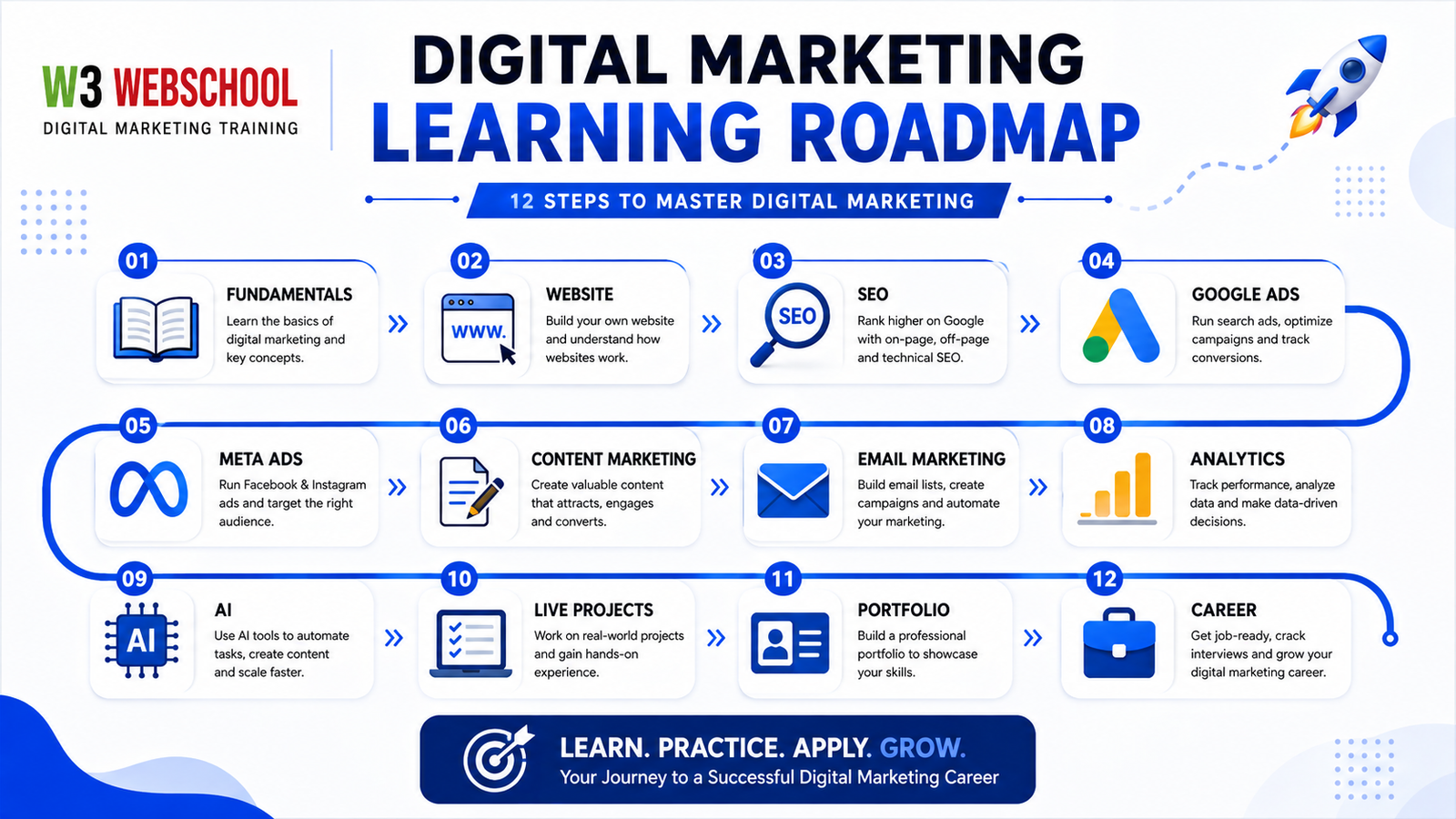
Digital Marketing Learning Roadmap 2026 Modules and Career Progression
ModuleKey Skills You'll LearnIndustry ToolsPractical ProjectCareer Outcome
Digital Marketing FundamentalsMarketing concepts, customer journey, funnelsGoogle Trends, ChatGPTDigital Marketing StrategyMarketing Executive
Website Planning & WordPressWebsite creation, landing pages, bloggingWordPress, ElementorBusiness WebsiteWebsite Administrator
Search Engine Optimization (SEO)Keyword research, on-page SEO, technical SEO, local SEOGoogle Search Console, GA4, Ahrefs, SemrushComplete SEO AuditSEO Executive
Google Ads (PPC)Search Ads, Display Ads, conversion trackingGoogle Ads, Keyword PlannerSearch CampaignPPC Executive
Meta AdsFacebook & Instagram advertising, remarketingMeta Ads ManagerLead Generation CampaignPerformance Marketing Executive
Social Media MarketingContent strategy, branding, engagementMeta Business Suite, CanvaMonthly Social Media PlanSocial Media Executive
Content MarketingSEO writing, blogging, content strategyChatGPT, GrammarlySEO Blog ProjectContent Writer
Email MarketingEmail campaigns, automationMailchimp, BrevoEmail FunnelEmail Marketing Executive
Google Analytics 4Traffic analysis, reports, conversionsGA4, Looker StudioAnalytics DashboardWeb Analytics Executive
YouTube MarketingVideo SEO, channel growthYouTube StudioChannel OptimisationYouTube Marketing Specialist
AI in Digital MarketingAI content, prompts, automationChatGPT, Gemini, Claude, NotebookLMAI Marketing WorkflowAI Digital Marketing Specialist
Freelancing & PortfolioClient communication, proposals, personal brandingLinkedIn, UpworkPortfolio WebsiteFreelancer / Consultant

What Makes This Syllabus Different?

Many digital marketing institutes still focus on traditional classroom teaching and outdated topics. A modern syllabus should prepare students for the way digital marketing teams actually work today.

The syllabus above is designed around four key learning outcomes:

Practical Learning

Every module includes practical assignments, real client case studies, and hands-on exercises instead of only theoretical lectures.

Industry Tools

Gain real experience with tools used by top agencies every day, including Google Analytics 4, Search Console, Google Ads, Meta Ads Manager and AI productivity platforms.

AI-Integrated Learning

Modern marketers rely on AI for research, content planning, campaign optimisation and workflow automation. Our syllabus introduces these tools responsibly alongside core principles.

Career Preparation

Learning leads directly to measurable outcomes such as portfolio development, mock interview practice, and the confidence to execute real client work.

Skills You'll Build Throughout This Syllabus

By completing all modules, learners gradually develop essential job-ready competencies:

  • Planning end-to-end digital marketing strategies.
  • Building and managing responsive WordPress websites.
  • Improving organic search engine visibility through SEO.
  • Planning and running high-converting paid advertising campaigns.
  • Creating search-optimized and engaging content.
  • Analysing site traffic and user behavior via Google Analytics 4.
  • Managing organic and paid social media growth strategies.
  • Using modern AI tools to scale overall team productivity.
  • Creating client-ready marketing performance reports and dashboards.
  • Building a verified professional portfolio for hiring interviews.
Expert Insight

A good digital marketing syllabus is not measured by the number of modules alone. The real value lies in how those modules connect through practical implementation, live projects and continuous skill development. Before enrolling in any course, check whether the curriculum reflects current industry practices, includes updated tools and provides opportunities to apply what you learn.

Looking for practical training based on these modules? Explore our Digital Marketing Course in Kolkata to understand how the complete syllabus is taught through live projects, mentor guidance and real-world assignments.

Module 1 — Digital Marketing Fundamentals

Every successful digital marketer starts by understanding the fundamentals. Before learning SEO, Google Ads, social media marketing or AI tools, it's important to know how digital marketing works as a complete ecosystem. This module introduces the core concepts that form the foundation of every digital marketing strategy.

Instead of focusing on a single platform, you'll learn how different digital channels work together to attract website visitors, generate qualified leads and convert them into long-term customers. Whether you're planning to work in a digital agency, join an in-house team or launch your own business, these fundamentals will help you understand the bigger picture before moving to advanced modules.

Why This Module Matters

Every successful digital marketing campaign begins with a strong understanding of the fundamentals. Before working with SEO, Google Ads or social media campaigns, marketers need to understand how customers search online, how businesses build their digital presence and how different marketing channels work together. This foundation makes it easier to learn advanced strategies in the later modules.

Why This Module Is Important

Many beginners jump directly into SEO or paid advertising without understanding the basics of marketing strategy. This often leads to confusion because they know how to use specific software tools but don't understand why a particular strategy succeeds or fails.

Learning the core fundamentals first helps you:

  • Understand the complete digital marketing ecosystem.
  • Learn how businesses attract and convert target audiences online.
  • Build a strong foundation before moving to technical modules.
  • Develop strategic thinking instead of relying only on execution tools.
  • Master customer behaviour and online buying decisions.

A solid foundation makes advanced modules like Search Engine Optimization, PPC Advertising and Web Analytics much easier to master.

Topics Covered in This Module

During this introductory module, students explore the fundamental pillars of digital strategy:

Introduction to Digital Marketing
Traditional vs Digital Marketing
Overview of Digital Marketing Channels
Marketing Funnels (TOFU, MOFU & BOFU)
Customer Journey & Touchpoints
Target Audience Research
Buyer Persona Creation
Business Goals & KPIs
Lead Generation Architecture
Organic vs Paid Media Channels
Branding & Online Reputation
Digital Marketing Terminology

Skills You'll Build

By the end of this module, you should be able to:

  • Explain clearly how different digital marketing channels operate together.
  • Identify the right marketing mix for different business models (B2B & B2C).
  • Map out customer journeys and design high-converting sales funnels.
  • Draft comprehensive initial digital marketing strategies.
  • Align campaign selection with core business ROI goals.
  • Build precise, data-driven customer buyer personas.

Real Industry Example

Imagine a coaching institute in Kolkata planning to increase student enquiries. Before launching SEO or paid advertising campaigns, the marketing team first identifies its target audience, defines business goals and understands how potential students search online. These are the same fundamentals every digital marketer learns before moving to advanced strategies.

Industry Tools You'll Learn

Although this is a foundational module, students gain hands-on orientation with essential entry-level platforms:

Google Trends
Discover trending industry topics and geographical search demand patterns.
Google Search
Perform competitive research and analyse competitor online presence.
ChatGPT
Brainstorm initial marketing ideas, campaign angles, and buyer personas.
Canva
Create basic visual concepts for social posts and funnel mapping.
Google Sheets
Organize campaign tracking, persona data, and marketing roadmaps.

Common Beginner Mistakes

  • Learning advanced tools before understanding marketing basics.
  • Focusing only on social media while ignoring search engines.
  • Confusing digital marketing with only running advertisements.
  • Trying to master every platform at the same time instead of building a strong foundation.

Practical Assignments & Mini Project

A high-quality digital marketing training program incorporates practical implementation from day one.

Example Practical Assignments:

  • Research a local business and define its ideal target audience profile.
  • Construct a detailed buyer persona using demographic and behavioral insights.
  • Map out a 3-stage (TOFU, MOFU, BOFU) sales funnel for a local service brand.
  • Perform a complete online audit of a competitor’s marketing channels.
Module Mini Project: Digital Marketing Strategy for a Local Business

At the end of Module 1, students complete a real-world strategic assignment covering:

  • Business Overview & Value Proposition
  • Primary Target Audience & Buyer Persona Card
  • Complete Lead Generation & Funnel Architecture
  • Recommended Paid & Organic Channel Selection
  • Expected KPIs and Business Growth Goals

Career Opportunities & Market Relevance

The strategic principles learned here provide the foundational backbone for various high-growth career roles:

  • Digital Marketing Executive
  • SEO Specialist / Consultant
  • PPC Advertising Executive
  • Social Media Strategist
  • Performance Marketer
Expert Insight

One pattern experienced trainers often notice is that students who spend time understanding the fundamentals usually find advanced topics much easier later. Instead of rushing through every platform, building a clear understanding of how digital marketing works as a complete system creates a much stronger foundation for long-term growth.

Once you've understood the fundamentals, the next step is learning how websites rank on Google through Search Engine Optimization. If you want practical training with mentor guidance and live projects, explore our Digital Marketing Course in Kolkata to see how these concepts are taught in a real classroom environment.

Module 2 — Website Planning & WordPress

A website is the foundation of digital marketing. Whether you're improving search engine rankings, running Google Ads campaigns, publishing blogs or generating real business leads, every digital marketing strategy begins with a well-structured website.

That's why Website Planning & WordPress is one of the most practical modules in a digital marketing course. Instead of only learning theory, students understand how professional websites are planned, designed and optimised for real users as well as search engines.

By the end of this module, you'll know how to create a responsive website, publish SEO-friendly content, build high-converting landing pages and manage a WordPress website without writing complex code.

Why This Module Is Important

Many beginners focus only on promotion channels while ignoring the platform where all marketing activities eventually lead—the website.

A professionally planned website helps businesses:

  • Build brand credibility and trust online.
  • Generate consistent customer enquiries and sales.
  • Improve overall Google search visibility.
  • Increase campaign conversion rates.
  • Deliver a seamless user experience across devices.
  • Support technical SEO and paid advertising campaigns.

Without a properly structured website, even the best marketing campaigns often fail to deliver consistent ROI.

Topics Covered in This Module

This module provides end-to-end practical execution covering:

Introduction to Websites & Architecture
Domain Name & Web Hosting Setup
Website Structure & Sitemap Planning
User Experience (UX) Basics
WordPress Installation & Configuration
Dashboard Overview & Settings
Essential Themes & Plugin Management
Elementor Page Builder Training
Website Navigation & Header/Footer Menus
Creating Pages & Publishing Blog Posts
Lead Capture Contact Forms
Image Compression & Optimisation
Mobile-Friendly Responsive Design
Website Speed Optimisation
Basic Website Security Practices
Website Backup & Maintenance Routines

Skills You'll Build

After completing this module, you'll be able to:

  • Plan a complete professional business website layout.
  • Purchase and map domains to hosting servers.
  • Install and manage WordPress sites independently.
  • Create custom responsive web pages using Elementor.
  • Publish properly formatted SEO-friendly blog articles.
  • Design high-converting lead generation landing pages.
  • Improve site usability, mobile responsiveness, and speed scores.
  • Maintain website security and automated regular backups.

Industry Tools You'll Learn

Gain hands-on experience using key tools that developers and web marketers work with daily:

WordPress
Content Management System (CMS) for site management.
Elementor
Drag-and-drop landing page and web design builder.
Rank Math / Yoast
Plugins for on-page SEO optimisation and schemas.
LiteSpeed Cache
Caching and speed performance plugin.
PageSpeed Insights
Core Web Vitals & site performance analysis.
Search Console
Google indexing setup & technical site monitoring.
GA4
Google Analytics 4 visitor tracking integration.
Canva
Designing website banners, icons, and hero images.

Practical Assignments & Live Project

Students participate in direct web building tasks that reflect actual agency deliverables.

Practical Assignments Include:

  • Connect a live domain name to hosting servers.
  • Deploy a fresh WordPress installation.
  • Design a custom home page using Elementor page builder.
  • Create contact forms with email notification routing.
  • Optimise site images to boost overall mobile loading speed.
Live Project: Complete Business Website Development

Students independently build a complete live website containing:

  • High-converting Home Page & About Us section
  • Services / Products Page setup
  • Functioning Blog Section with SEO-friendly URLs
  • Lead Generation Contact Page
  • Fully Responsive Mobile & Desktop Design
  • Basic On-Page SEO & Analytics Tracking Setup

Career Opportunities

Website planning and management skills qualify you for several high-demand job profiles:

  • Digital Marketing Executive
  • WordPress Administrator / Developer
  • SEO & Technical Web Executive
  • Content Operations Specialist
  • Freelance Web Designer / Consultant

Common Beginner Mistakes to Avoid

Avoid these common website setup mistakes when starting out:

  • Poor sitemap layout making navigation confusing for users.
  • Ignoring mobile responsiveness testing during design.
  • Uploading uncompressed, heavy images that slow down load speed.
  • Installing bloatware with too many unnecessary plugins.
  • Forgetting to setup Search Console indexing and GA4 analytics.
Expert Insight

A digital marketer doesn't need to become a full-stack web developer, but understanding how websites function is a massive career advantage. Professionals who can build custom landing pages, fix performance issues and manage WordPress sites contribute far more effectively to SEO, paid advertising, and overall lead generation campaigns.

Once your website is ready, the next step is making it visible on Google through Search Engine Optimization. If you want to learn website creation, SEO and digital marketing together with live projects, explore our Digital Marketing Course in Kolkata to understand how these practical skills are taught.

Module 3 — Search Engine Optimization (SEO)
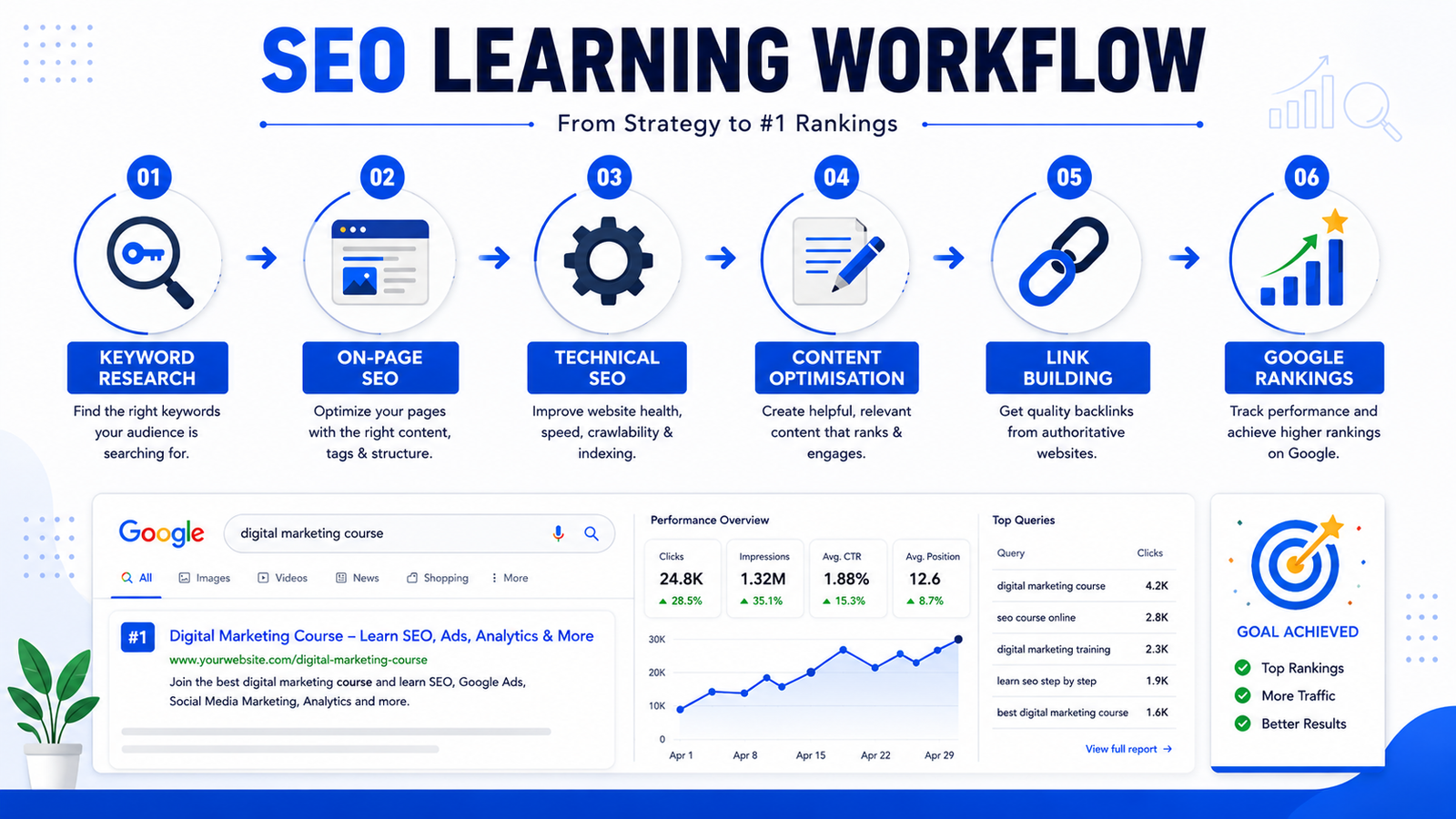
SEO Learning Workflow Infographic - On-Page, Off-Page, and Technical SEO Strategy

Search Engine Optimization (SEO) is one of the most valuable skills in digital marketing because it helps businesses attract organic traffic from search engines without paying for every click. A strong understanding of SEO enables marketers to improve website visibility, generate qualified leads and build long-term online growth.

This module introduces both the fundamentals and practical implementation of SEO, covering everything from keyword research to technical SEO optimisation and local SEO.

Why SEO Is One of the Most Valuable Digital Marketing Skills

Search Engine Optimization is often considered one of the most sustainable digital marketing skills because it helps businesses attract organic traffic without paying for every visitor. Whether it's a local business, an e-commerce store or a service provider, strong SEO practices can improve online visibility and generate consistent long-term results. That's why SEO remains a core part of almost every modern digital marketing strategy.

What You'll Learn

During this module, you'll learn how to master key organic search strategies:

  • Understand how Google search algorithms rank web pages.
  • Perform keyword research based on user search intent.
  • Optimise page titles, meta descriptions, headings, and content.
  • Improve website structure and internal linking strategies.
  • Optimise images, core web vitals, and mobile page speed.
  • Understand Technical SEO fundamentals like canonicals and XML sitemaps.
  • Create an effective Local SEO strategy using Google Business Profile.
  • Build high-quality backlinks through ethical off-page SEO techniques.
  • Measure SEO performance using essential web analytics tools.

Real Industry Example

Consider a coaching institute in Kolkata that wants to appear when students search for terms like "digital marketing course in Kolkata." Before publishing content, the marketing team researches search intent, identifies relevant keywords, improves page structure and creates helpful content. Over time, these efforts help increase organic visibility and attract visitors who are actively looking for that service. This practical workflow reflects how SEO is applied in real business environments.

Industry Standard SEO Tools

Master industry-standard SEO platforms used by agencies worldwide:

Search Console
Index monitoring, sitemaps, and search performance tracking.
Google Analytics 4
Organic user behavior, traffic analysis, and goal conversion tracking.
Keyword Planner
Discover search volume, keyword trends, and commercial intent.
Ahrefs / Semrush
Competitor analysis, keyword difficulty, and backlink auditing.
Screaming Frog
Technical SEO site audits, broken links, and crawl analysis.

Common Beginner Mistakes

  • Targeting keywords without understanding search intent.
  • Publishing content without proper heading structure.
  • Ignoring technical SEO issues such as page speed and indexing.
  • Expecting immediate rankings after publishing content.
  • Focusing only on keywords instead of creating genuinely helpful content.

Practical Assignment & Audit Project

Hands-on SEO Project

Students gain practical experience by performing a complete on-page SEO audit of a live website. You will:

  • Identify and fix broken links, missing meta tags, and technical crawl errors.
  • Optimise a core service page for target transactional keywords.
  • Write and publish an SEO-friendly blog article targeting specific long-tail queries.

Where Businesses Use SEO

SEO is widely used across different industries to improve online visibility and attract qualified visitors through search engines. Common examples include:

  • Educational institutes targeting student enquiries.
  • E-commerce websites increasing product visibility.
  • Healthcare clinics attracting local patients.
  • Real estate companies generating property leads.
  • Restaurants and local businesses improving local search presence.

Career Opportunities

Mastering Search Engine Optimization opens up several dedicated career paths:

  • SEO Executive
  • SEO Analyst / Strategist
  • Organic Growth Executive
  • Content SEO Specialist

Additionally, strong SEO knowledge significantly strengthens your capabilities in content marketing, website optimization, and organic lead generation.

Expert Insight

One of the biggest lessons experienced SEO professionals learn is that rankings improve when content genuinely solves users' problems. While keyword research and technical optimisation remain important, understanding search intent and creating useful, well-structured content often makes the biggest difference over the long term.

If you want to specialise in organic search, technical SEO and live website optimisation, you can also explore our SEO Course in Kolkata for dedicated practical training.

Module 5 — Meta Ads (Facebook & Instagram Marketing)

Meta Ads is one of the most effective digital marketing channels for generating brand awareness, website traffic, qualified leads, and online sales. Through Facebook and Instagram, businesses can reach highly targeted audiences based on demographics, interests, online behaviour, and purchase intent.

This module teaches you how to create, manage, and optimise performance campaigns using Meta Ads Manager. You'll also learn how businesses leverage remarketing and advanced audience segmentation to improve campaign performance and maximize overall return on investment (ROI).

What You'll Learn

In this module, you'll master essential concepts and execution steps for Meta advertising:

  • Comprehensive introduction to Meta Ads Manager.
  • Navigating the Facebook & Instagram advertising ecosystem.
  • Mapping campaign objectives to real business marketing goals.
  • Advanced audience targeting and building Custom Audiences.
  • Scaling reach with high-converting Lookalike Audiences.
  • Designing ad creatives and copywriting fundamentals that drive action.
  • Strategic budget allocation, bid strategies, and cost controls.
  • Meta Pixel integration and Conversions API (CAPI) basics.
  • Creating native lead generation campaigns with instant forms.
  • Designing dynamic remarketing and retargeting funnel campaigns.
  • Continuous ad set optimisation, A/B testing, and reporting analytics.

Industry Standard Tools You'll Learn

Build practical confidence using key software required for paid social marketing:

Meta Ads Manager
Official workspace for setting up, targeting, and managing ad campaigns.
Meta Business Suite
Centralized management for Facebook Pages, Instagram accounts, and assets.
Meta Pixel
Tracking site events, web visitor behavior, and conversion attribution.
Canva
Designing high-CTR social media ad graphics, carousels, and stories.
GA4
Analyzing paid social traffic pathways and cross-channel conversion performance.

Practical Assignment & Live Campaign Design

Hands-on Lead Generation Campaign Project

Students build a complete lead generation campaign from scratch. Practical steps include:

  • Selecting the optimal campaign objective and configuring instant lead forms.
  • Defining target buyer personas based on demographics and behavioral interests.
  • Designing high-converting visual ad creatives and writing persuasive ad copy.
  • Setting campaign daily budgets, lifetime caps, and schedules.
  • Analyzing ad set performance, Cost Per Lead (CPL), and CTR metrics in Meta Ads Manager.

Career Opportunities

Proficiency in Facebook and Instagram advertising opens doors to high-growth paid social roles:

  • Social Media Advertising Executive
  • Meta Ads Specialist
  • Performance Marketing Executive
  • Paid Social Media Strategist
  • Digital Marketing Executive

These skills are heavily sought after by marketing agencies, D2C startups, e-commerce brands, and businesses relying on paid social campaigns for customer acquisition.

Expert Tip

Successful Meta advertising is not just about boosting posts. High-performing campaigns are built on clear objectives, precise audience targeting, compelling visual creatives, and continuous optimization based on campaign performance data. Rigorously testing different audiences, ad formats, and messaging variations is often the single biggest key to scaling your ROAS over time.

Want to master Meta Ads Manager, advanced audience retargeting, and performance social campaigns through hands-on practical training? Explore our Digital Marketing Course in Kolkata to gain real campaign experience with industry experts.

Module 6 — Social Media Marketing (SMM)

Social Media Marketing (SMM) is one of the most powerful ways for businesses to build brand awareness, engage with target customers, and generate organic leads. Today, platforms like Facebook, Instagram, LinkedIn, X (Twitter), and YouTube are not just social networking sites—they are essential core marketing channels used by businesses of every size.

This module teaches you how to create platform-specific content, establish a consistent brand presence, boost organic audience engagement, and measure social media ROI. Instead of simply posting content randomly, you'll learn how to develop structured campaigns aligned with actual business goals and consumer behavior.

What You'll Learn

During this module, you'll gain practical knowledge of key organic social strategies:

  • Fundamentals of strategic Social Media Marketing.
  • Selecting the right platforms based on specific target audience demographics.
  • Building an end-to-end social media strategy from scratch.
  • Creating structured content calendars and publishing schedules.
  • Establishing brand positioning and visual design consistency.
  • Maximising organic reach and community engagement.
  • Strategic hashtag research and search optimization for social feeds.
  • Community management and reputation handling practices.
  • Influencer marketing frameworks and outreach strategies.
  • Tracking social media metrics, performance analytics, and growth.

Industry Standard Tools You'll Learn

Gain hands-on proficiency with essential social management and design software:

Meta Business Suite
Official workspace for scheduling, publishing, and managing Facebook & Instagram.
Canva
Designing engaging social graphics, carousel posts, and video reels.
Buffer / Hootsuite
Automated multi-platform post scheduling and content queuing.
Meta Insights
Analyzing organic page performance, reach, and follower growth.
Google Analytics 4
Measuring website traffic and conversions driven by social channels.

Practical Assignment & Campaign Execution

Hands-on 30-Day Content Planning Project

Students build a complete 30-day social media content calendar for a real-world business. Practical tasks include:

  • Developing strategic post themes, engaging captions, and targeted hashtag sets.
  • Designing creative visual assets and reels using Canva.
  • Planning structured publishing schedules across multiple social channels.
  • Evaluating engagement metrics to identify top-performing content formats.

Career Opportunities

Mastering social media marketing opens doors to multiple exciting digital roles:

  • Social Media Executive
  • Social Media Manager
  • Community Manager
  • Brand Marketing Executive
  • Digital Marketing Executive

These SMM skills are highly valued across advertising agencies, tech startups, e-commerce stores, and corporate brands relying on social channels for growth.

Expert Tip

Many beginners focus solely on increasing follower counts, but successful social media marketing is measured by meaningful audience engagement, lead generation, and measurable business growth. Consistently publishing high-value content and regularly analyzing performance analytics is far more effective than chasing short-term viral trends.

Want to master social media strategies, organic channel growth, and content marketing with hands-on live projects? Explore our Digital Marketing Course in Kolkata to build industry-ready skills under expert mentorship.

Module 7 — Content Marketing

Content Marketing is the process of creating and distributing valuable, relevant, and helpful content to attract, educate, and convert potential customers. Instead of directly promoting products or services, businesses use blogs, articles, landing pages, videos, case studies, and email content to build trust and establish long-term relationships with their audience.

In digital marketing, high-quality content supports almost every channel, including SEO, social media marketing, email marketing, and paid advertising. This module teaches you how to plan, create, and optimise content that serves both real users and search engine algorithms.

Why Content Marketing Matters

Every digital marketing channel relies on quality content. Whether someone discovers a business through Google Search, social media, email campaigns or paid advertisements, useful and relevant content plays a key role in building trust. Learning content marketing helps you create information that not only attracts visitors but also encourages them to take meaningful actions.

What You'll Learn

This module covers the essential practical skills required to build effective digital content strategies:

  • Core Content Marketing strategy fundamentals.
  • Analyzing and mapping user search intent.
  • Strategic keyword research for content planning.
  • High-ranking SEO blog writing techniques.
  • High-converting landing page copywriting.
  • Professional website copy and brand content creation.
  • Structuring editorial workflows and content calendars.
  • Leveraging AI-assisted content creation tools ethically.
  • On-page content optimisation for search engine rankings.
  • Tracking metrics and measuring content performance analysis.

Real Industry Example

Imagine a student searching for "digital marketing course syllabus." Instead of publishing a short page with basic information, an institute creates a detailed guide that explains modules, tools, projects, career opportunities and practical skills. Because the content answers multiple user questions in one place, it has a better chance of earning trust and improving visibility in search results. This is a practical example of how content marketing supports SEO and user experience together.

Industry Standard Tools You'll Learn

Gain practical proficiency using core writing, research, and analytics software:

Google Docs
Collaborative content writing, drafting, and editorial review.
Grammarly
Grammar verification, tone enhancement, and readability scoring.
ChatGPT
Content ideation, topic research, outlines, and drafting support.
Google Trends
Discovering trending market topics and search interest shifts.
Search Console
Monitoring organic blog rankings, clicks, and search impressions.
Canva
Designing featured blog graphics, infographics, and visual elements.

Common Beginner Mistakes

  • Writing only for search engines instead of real readers.
  • Publishing articles without understanding user intent.
  • Ignoring headings and content structure.
  • Using AI-generated text without proper editing.
  • Updating content rarely, even when information changes.

Practical Assignment & Blog Publication

Hands-on Live SEO Publishing Project

Students independently plan, draft, and publish a complete SEO-friendly blog article. Tasks include:

  • Performing targeted keyword research and crafting structured content outlines.
  • Writing comprehensive blog copy targeting specific long-tail queries.
  • Optimising meta titles, heading structures (H1, H2, H3), and image alt tags.
  • Publishing and formatting the completed article live on a WordPress platform.

Where Businesses Use Content Marketing

Content marketing is widely used to educate audiences, improve search visibility and build long-term trust. It is commonly applied in:

  • Educational websites publishing career guides.
  • E-commerce businesses creating buying guides.
  • Healthcare organisations answering common patient questions.
  • SaaS companies producing product tutorials.
  • Local businesses sharing informative blogs to attract nearby customers.

Career Opportunities

Strong content skills prepare learners for specialised digital marketing and writing roles:

  • SEO Content Writer
  • Content Marketing Executive
  • Conversion Copywriter
  • Blog Writer / Editor
  • Content Strategist
  • Digital Marketing Executive

High-level writing expertise also directly elevates your performance in organic SEO, social media management, and email lead generation campaigns.

Expert Insight

Publishing a high volume of content doesn't automatically guarantee better search rankings. Successful content marketing focuses on solving genuine user problems, addressing exact search intent, and delivering original insights backed by practical experience. High-quality structure and real user value will consistently outperform low-quality AI filler and outdated keyword stuffing. One of the biggest differences between average and high-performing content is usefulness. Articles that answer real questions, explain concepts clearly and stay updated over time are more likely to build trust with readers than pages written only to target keywords.

If you want to improve your SEO writing, blog strategy, and website copywriting skills in greater depth, you can also explore our Content Writing Course in Kolkata for dedicated practical creation and optimisation training.

Module 8 — Email Marketing

Email Marketing remains one of the highest ROI digital marketing channels because it helps businesses build long-term customer relationships, nurture leads, and increase repeat online sales. Unlike social media platforms, where algorithm shifts control visibility, email allows businesses to communicate directly with their target audience through personalized and automated sequences.

In this module, you'll learn how to build targeted email subscriber lists, design professional broadcast newsletters, automate complex customer journeys, and measure campaign performance metrics using industry-standard email marketing automation platforms.

What You'll Learn

This module focuses on the practical execution and technical aspects of modern email marketing:

  • Fundamentals of strategic Email Marketing.
  • Lead magnet creation and building clean email subscriber lists.
  • Advanced email list segmentation for higher engagement.
  • Designing responsive newsletters and visual layouts.
  • Structuring high-converting promotional and transactional emails.
  • Building automated email marketing workflows.
  • Designing automated welcome email sequences.
  • Crafting drip campaigns for effective lead nurturing.
  • Applying dynamic email personalization and tags.
  • Executing subject line and content A/B testing.
  • Analyzing deliverability, open rates, CTR, and conversions.
  • Spam compliance and email marketing deliverability best practices.

Industry Standard Tools You'll Learn

Master leading CRM platforms and marketing automation software:

Mailchimp
Designing email templates, audience tags, and managing newsletters.
Brevo (Sendinblue)
Setting up advanced marketing automation, SMS, and transactional emails.
MailerLite
Building clean drag-and-drop newsletters and subscriber landing pages.
ConvertKit
Creator-focused email automation, tag-based funnels, and sequences.
Google Analytics 4
Tracking email campaign traffic, sales attribution, and UTM links.

Practical Assignment & Automation Setup

Hands-on Live Email Campaign & Workflow Project

Students build and execute a complete email marketing campaign from scratch. Practical steps include:

  • Designing a visually engaging newsletter template aligned with brand assets.
  • Segmenting subscribers based on interests, demographics, or purchase behavior.
  • Configuring an automated multi-step welcome email sequence for new signups.
  • Analyzing real campaign metrics including open rates, click-through rates (CTR), and sales conversions.

Career Opportunities

Proficiency in email marketing automation opens direct paths to specialized CRM and performance roles:

  • Email Marketing Executive
  • CRM Executive
  • Marketing Automation Executive
  • Lifecycle Marketing Specialist
  • Digital Marketing Executive

These core skills are highly prized across e-commerce businesses, SaaS platforms, corporate agencies, and educational institutions relying on customer retention.

Expert Tip

Successful email marketing is built on trust and relevance—not sheer email volume. Sending fewer, highly targeted emails with valuable content consistently produces superior open rates, higher CTR, and increased conversion rates compared to sending frequent promotional messages to your entire subscriber list.

Want to master email automation, CRM lead nurturing, and performance digital marketing through hands-on industry projects? Explore our Digital Marketing Course in Kolkata to build practical skills under expert guidance.

Module 9 — Google Analytics 4 (GA4)

Google Analytics 4 (GA4) is one of the most essential tools in digital marketing because it empowers businesses to understand exactly how users interact with their websites. Instead of relying on guesswork, GA4 provides real-time data on website traffic, user behavior, conversions, and performance marketing success.

In this module, you'll learn how to collect, analyze, and interpret web analytics data to refine overall marketing strategies and make data-driven decisions. Whether managing SEO, Google Ads, or paid social campaigns, understanding analytics is critical for measuring ROI and uncovering optimization opportunities.

What You'll Learn

This module covers key analytics frameworks and practical techniques in Google Analytics 4:

  • Core architecture of Google Analytics 4 (GA4).
  • GA4 account setup, property configuration, and data streams.
  • Configuring custom Events and Conversions tracking.
  • Navigating and building User Acquisition Reports.
  • Detailed traffic source analysis (Organic, Paid, Direct, Referral).
  • Evaluating user engagement, page views, and bounce behavior.
  • Advanced audience segmentation and dynamic grouping.
  • Goal tracking and cross-channel conversion tracking.
  • Campaign tracking setup using UTM parameters.
  • Building custom exploration reports and tailormade dashboards.
  • Basic interactive reporting using Looker Studio.
  • Utilizing web analytics insights for marketing optimization.

Industry Standard Tools You'll Learn

Gain practical experience using leading data analytics, tracking, and dashboard tools:

Google Analytics 4
Official workspace for measuring website analytics and user activity.
Google Tag Manager
Deploying tracking tags, event triggers, and pixels without coding.
Looker Studio
Building visual, interactive dashboards for client reporting.
Google Search Console
Monitoring organic query rankings, search impressions, and indexing.
Google Ads
Linking paid ad accounts for direct ROAS and conversion tracking.

Practical Assignment & Live Analytics Setup

Hands-on GA4 Implementation & Dashboard Project

Students independently set up and configure an end-to-end analytics workflow. Tasks include:

  • Setting up a GA4 property and connecting the measurement code to a live website.
  • Creating custom conversion events using Google Tag Manager (GTM).
  • Analyzing user acquisition channels and evaluating traffic quality metrics.
  • Building an automated Looker Studio report to present campaign ROI visually.

Career Opportunities

Technical analytics proficiency opens high-demand opportunities across analytical digital roles:

  • Web Analytics Executive
  • Digital Marketing Analyst
  • Performance Marketing Executive
  • SEO Analyst
  • Growth Marketing Executive

Data skills are indispensable across enterprises, agencies, and tech companies seeking to optimize marketing budgets and scale customer acquisition effectively.

Expert Tip

Successful digital marketers don't rely solely on basic traffic volume. They systematically analyze user behavior, conversion funnels, and engagement rates to make actionable decisions. Mastering GA4 reports enables you to pinpoint drop-offs, optimize campaign spend, and demonstrate measurable business results with confidence.

Want to master Google Analytics 4, Tag Manager, and data-driven growth strategies through practical client projects? Explore our Digital Marketing Course in Kolkata to gain advanced technical training from certified experts.

Module 10 — AI in Digital Marketing

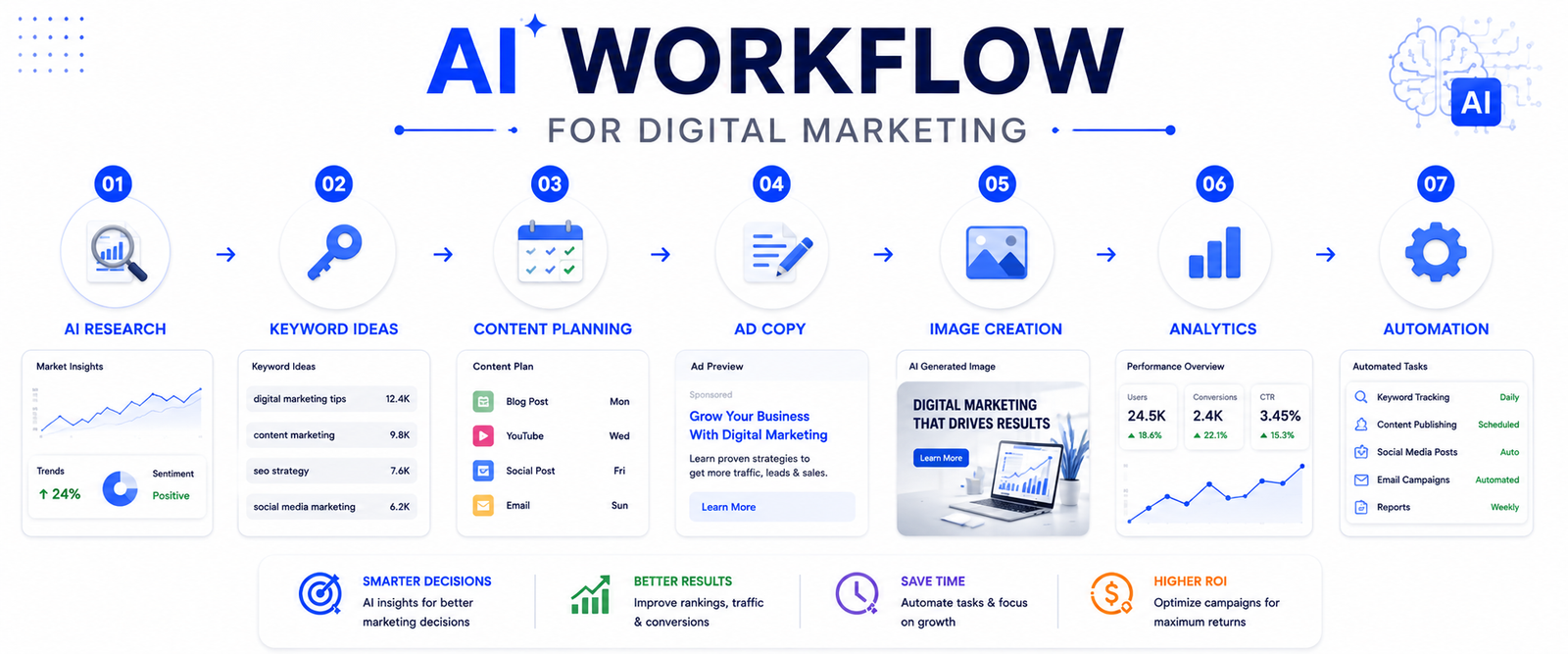
AI Workflow for Digital Marketing Infographic - Artificial Intelligence Automation, Content Generation, and Marketing Strategy

Artificial Intelligence (AI) is transforming the way digital marketers research keywords, create content, optimise ad campaigns, and analyse performance data. Today, digital agencies, startups, and enterprises leverage AI-powered marketing tools to boost productivity, automate repetitive workflows, and make faster, data-driven decisions.

However, AI is most powerful when combined with human creativity, critical thinking, and core strategic principles. This module introduces practical applications of AI in digital marketing, helping learners accelerate execution while preserving content quality, brand tone, and original strategy.

Why AI Is Becoming an Important Marketing Skill

AI has become a valuable productivity tool in digital marketing, helping professionals complete routine tasks more efficiently. From content research and keyword clustering to campaign planning and data analysis, AI can save time and improve workflows. However, successful marketers still rely on human judgement, creativity and strategic thinking to make informed decisions and deliver meaningful results.

What You'll Learn

This module focuses on real-world, industry-tested AI tools and prompt workflows:

  • Fundamentals of Artificial Intelligence in Digital Marketing.
  • Executing AI-powered keyword research and intent mapping.
  • Dynamic AI content planning and topic research techniques.
  • Advanced prompt engineering fundamentals for marketers.
  • Creating AI-assisted SEO content and article outlines.
  • Generating social media posts, captions, and reel scripts with AI.
  • Core concepts of AI image generation for ad visual design.
  • Leveraging AI for Google Ads and Meta Ads optimization.
  • Streamlining AI-based email marketing sequences and copy.
  • AI productivity hacks and marketing workflow automation.
  • Principles of AI ethics, copyright compliance, and responsible usage.

Real Industry Example

Imagine you're planning a blog on "Digital Marketing Course Syllabus." Instead of starting with a blank page, AI can help organise topic ideas, suggest related questions and identify supporting keywords. The marketer then reviews the information, verifies facts, adds personal insights and creates original content that genuinely helps readers. This combination of AI assistance and human expertise reflects how many professionals work today.

Industry Standard Tools You'll Learn

Master leading generative AI models and intelligent marketing platforms:

ChatGPT
Advanced content research, copywriting, and campaign ideation.
Google Gemini
Real-time web research, multi-modal analysis, and strategy drafting.
Claude
Long-form editorial content writing, detailed tone styling, and document analysis.
NotebookLM
Grounded source research, document synthesis, and insight summaries.
Canva AI
AI-assisted graphic generation, visual editing, and creative magic tools.
Perplexity AI
Factual research discovery and cited topic validation.

Where AI Helps — And Where It Doesn't

AI Can Help With

  • Keyword and topic research
  • Content outlines and brainstorming
  • Ad copy ideas
  • Basic data analysis
  • Productivity and workflow automation

Human Skills Are Still Essential For

  • Marketing strategy
  • Understanding customer behaviour
  • Creative storytelling
  • Brand communication
  • Final content review and quality control

Practical Assignment & AI Project Workflow

Hands-on AI Marketing Campaign Project

Students complete a full-cycle, AI-assisted marketing project balancing smart tools with human strategic review. Tasks include:

  • Performing deep niche and audience persona research using generative AI tools.
  • Generating high-intent keyword opportunities and structured editorial outlines.
  • Drafting SEO-friendly web copy and refining outputs through human editing and fact-checking.
  • Designing promotional social media assets and crafting a complete campaign framework.
  • Auditing AI outputs for originality, accuracy, and search compliance.

Practical AI Exercise

Choose a marketing topic and use an AI tool to generate an initial content outline. Review the output, verify the information, improve the structure, add original insights and rewrite sections where needed. This exercise helps students understand that AI works best as a support tool rather than a replacement for critical thinking.

Career Opportunities

Combining core marketing skills with AI proficiency unlocks modern growth and executive roles:

  • AI Digital Marketing Executive
  • SEO Executive
  • Content Marketing Specialist
  • Performance Marketing Executive
  • Marketing Automation Executive
  • Growth Marketing Executive
  • Freelance Digital Marketer

Marketers who master both core strategic principles and AI-driven efficiency are among the most sought-after professionals in the modern hiring market.

Expert Insight

AI should be viewed as a high-speed productivity assistant rather than a full replacement for human marketing expertise. High-performing marketers use AI tools to accelerate research, organize ideas, and automate repetitive tasks, while relying on personal judgment to deliver trustworthy, audience-focused campaigns. Strategic domain knowledge, understanding user intent, and business goal alignment remain indispensable. Experienced marketers use AI to improve efficiency, not to replace expertise. The strongest results usually come from combining AI-assisted workflows with practical knowledge, careful editing and a clear understanding of user intent.

Ready to supercharge your career with AI-powered marketing techniques, advanced search engine strategies, and live client projects? Explore our Digital Marketing Course in Kolkata to master modern digital skills under expert guidance.
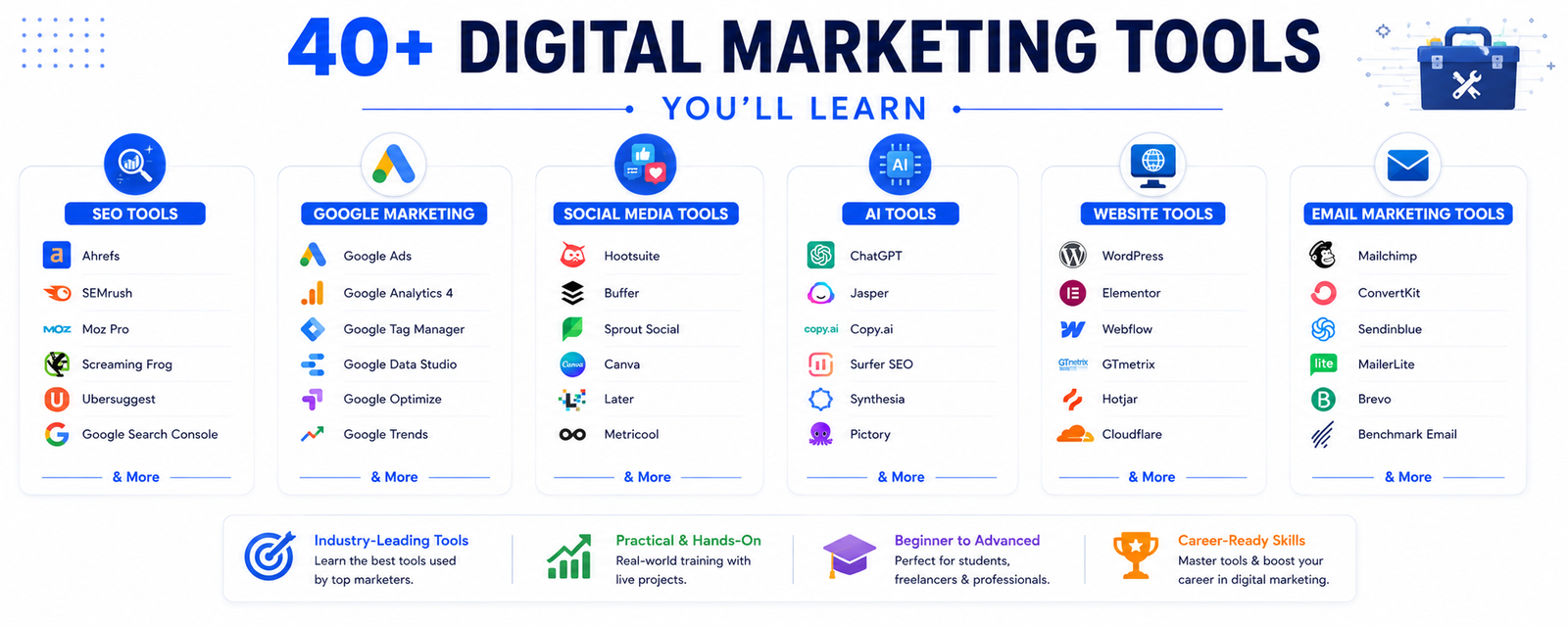
40+ Digital Marketing Tools You Will Learn Infographic - SEO, PPC, Analytics, Social Media & AI Software

40+ Digital Marketing Tools You'll Learn During the Course

SEO & Website Optimisation
Google Search Console
Website indexing, crawl error diagnostic, and organic performance monitoring.
Google Keyword Planner
Search volume discovery and pay-per-click keyword research.
Google Trends
Search interest tracking and real-time market trend analysis.
Ahrefs
Backlink auditing, link building metrics, and competitor analysis.
Semrush
Comprehensive SEO audits, rank tracking, and competitor keyword research.
Screaming Frog
Technical SEO crawling, broken link identification, and site architecture checks.
Website & Landing Page Tools
WordPress
Content management system (CMS) setup, management, and blogging.
Elementor
Drag-and-drop visual landing page building and conversion design.
Rank Math SEO
On-page SEO optimization, schema markup, and sitemap generation.
LiteSpeed Cache
Website performance acceleration, image optimization, and caching.
Google Marketing Tools
Google Ads
Creating and scaling PPC search, display, and video campaigns.
Google Analytics 4 (GA4)
Web analytics, user behavior tracking, and multi-channel attribution.
Google Tag Manager
Event tracking deployment, pixel setup, and code container control.
Looker Studio
Building interactive cross-platform marketing dashboards and reports.
Meta & Social Media Tools
Meta Ads Manager
Targeted paid campaign setup across Facebook and Instagram.
Meta Business Suite
Centralized social media posting, inbox management, and insights.
Canva
Designing social post graphics, ad banners, and promotional content.
Buffer
Automated social media scheduling and content publishing.
AI & Productivity Tools
ChatGPT
Content planning, prompt execution, and copy drafting.
Google Gemini
Real-time market research, idea expansion, and live web query analysis.
Claude
Detailed long-form content generation and structured editing.
NotebookLM
Research organization and source-grounded documentation synthesis.
Perplexity AI
Factual research discovery and instant cited web search.
Canva AI
Smart image generation, object removal, and automated creative design.
Email Marketing Tools
Mailchimp
Email marketing automation, list segmentation, and campaign tracking.
Brevo
Omnichannel transactional emails, SMS marketing, and automation workflows.
MailerLite
Newsletter design, subscriber list growth, and landing page creation.
Collaboration & Productivity
Google Docs
Real-time collaborative content writing and editorial feedback.
Google Sheets
Campaign planning, keyword tracking, and performance data sheets.
Google Drive
Secure cloud asset storage and media file organization.
Trello
Kanban project management and task delegation for team projects.
Notion
Centralized content strategy wikis, roadmaps, and documentation.
Expert Insight

While marketing software continually evolves, mastering core strategic frameworks alongside current tools ensures long-term career adaptability. Focus on understanding the primary objective, user behavior metrics, and underlying logic behind each platform rather than just memorizing dynamic user interfaces.

Live Projects You'll Work On During a Digital Marketing Course
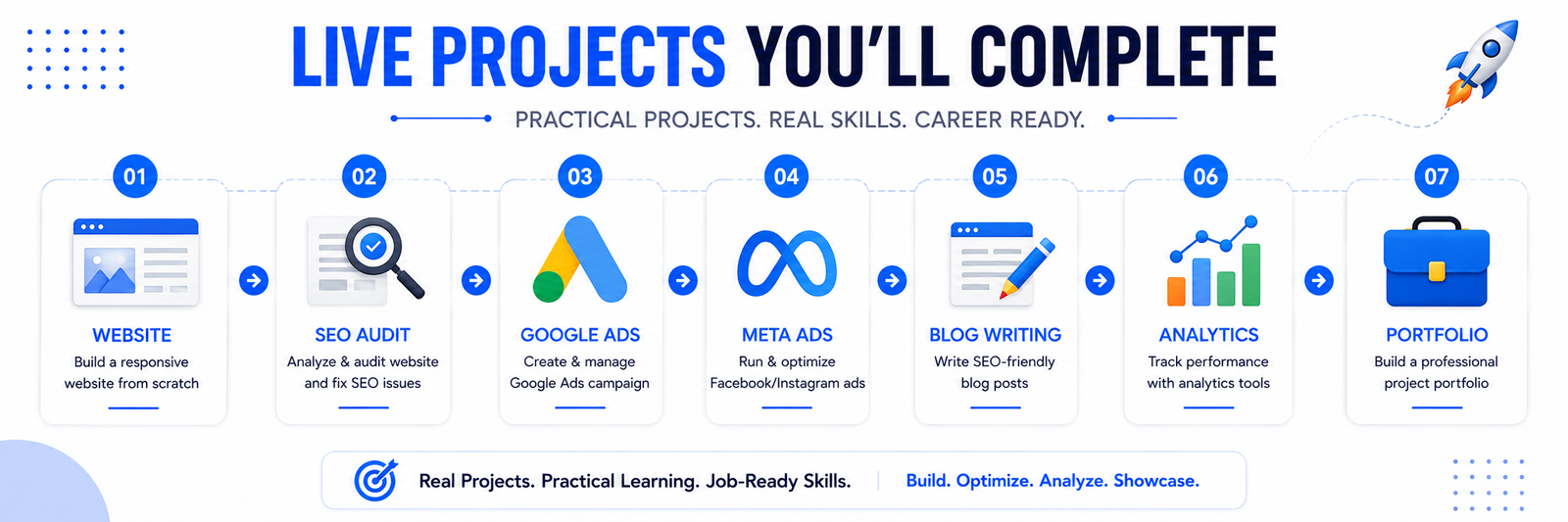
Live Digital Marketing Projects Roadmap Infographic - Practical Course Work & Portfolio Building

Why Live Projects Are Important

Learning digital marketing becomes much more effective when concepts are applied in real situations. Live projects give students an opportunity to work on practical tasks such as website optimisation, content creation, SEO implementation and campaign management. This hands-on experience helps bridge the gap between classroom learning and the expectations of employers or clients.

Real Industry Example

Imagine a local business wants to improve its online visibility. Instead of working on a sample exercise, students analyse the website, identify SEO opportunities, optimise important pages, prepare content recommendations and review performance using analytics tools. This practical workflow reflects the type of work digital marketers commonly perform on real projects.

Live Projects Included
Live ProjectSkills You'll PracticeIndustry Tools
Business Website CreationWebsite Planning, UX, WordPressWordPressElementor
SEO Website AuditOn-Page & Technical SEOSearch ConsoleScreaming Frog
Keyword Research ProjectSearch Intent AnalysisKeyword PlannerAhrefs
Google Ads CampaignPPC Strategy & OptimisationGoogle Ads
Meta Lead Generation CampaignAudience TargetingMeta Ads Manager
SEO Blog WritingContent MarketingChatGPTGrammarly
Social Media Content CalendarContent PlanningCanvaMeta Business Suite
Email Marketing CampaignAutomation & SegmentationMailchimp
Google Analytics DashboardData AnalysisGA4Looker Studio
Complete Digital Marketing StrategyEnd-to-End Campaign PlanningMultiple Industry Tools

Skills You Build During Live Projects

Working on live projects helps develop practical skills that are difficult to gain through theory alone, including:

  • Planning digital marketing activities.
  • Solving real website and campaign challenges.
  • Using professional marketing tools confidently.
  • Analysing performance and making improvements.
  • Presenting completed work in a professional portfolio.
Portfolio You'll Build
A responsive WordPress website
SEO audit report
Keyword research document
Published SEO blog article
Google Ads campaign structure
Meta Ads campaign plan
30-day social media content calendar
Email marketing workflow
Google Analytics performance dashboard
Complete digital marketing strategy presentation

What Employers Usually Expect

While hiring freshers, many employers look beyond certificates. They often prefer candidates who can explain how they approached a project, the tools they used, the challenges they faced and the improvements they suggested. Practical project experience demonstrates problem-solving ability and makes interview discussions more meaningful.

Industry Experience You'll Gain

Instead of learning isolated tools, students experience how different marketing activities connect together in real agencies:

Website SEO Content Google Ads Social Media Email Marketing Analytics Optimisation
Expert Insight

A certificate alone rarely impresses recruiters. Demonstrating practical work through live projects and a well-organised portfolio often has a greater impact during interviews. When evaluating a digital marketing course, always check whether the syllabus includes meaningful project work rather than only classroom lectures. Completing a project is only one part of the learning process. The real value comes from understanding why a particular strategy was chosen, what results were observed and how future improvements can be made. This habit of analysing outcomes is what gradually builds professional confidence.

What Skills Will You Gain After Completing This Digital Marketing Course Syllabus?

Search Engine Optimization (SEO)

Learn how search engines discover, understand and rank web pages. Know how to improve website visibility by researching keywords, optimising content, fixing technical issues and building logical site architecture.

Paid Advertising

Build high-converting campaigns, select target audiences, write effective ad copy, track conversion pixels, and optimize ROAS based on real campaign analytics.

Content Strategy

Identify user search intent, organize information clearly, create high-value content, and optimize pages so they effectively address user queries while boosting organic traffic.

Website Management

Gain practical experience managing WordPress sites, publishing optimized landing pages, updating site content, and improving UX without relying on web developers.

Data Analysis

Master Google Analytics 4 (GA4) and Search Console to analyze traffic sources, track user behavior paths, and make data-backed growth decisions instead of relying on assumptions.

Social Media Management

Understand platform-specific audience demographics. Plan content calendars, maintain brand consistency, boost organic engagement, and measure post performance.

AI-Assisted Marketing

Use generative AI tools responsibly to speed up market research, keyword discovery, copy generation, and workflow automation while keeping strategic human oversight intact.

Marketing Strategy

Understand how SEO, paid ads, social media, and email marketing work together to build multi-channel conversion funnels that generate leads and drive scalable business growth.

Skills Summary
Plan a digital marketing strategy for a business
Build and manage a WordPress website
Improve search engine visibility through SEO
Create and optimise Google Ads and Meta Ads
Write search-friendly content
Analyse website performance using GA4
Plan social media content calendars
Use AI tools to improve marketing productivity
Build a portfolio through practical projects
Work confidently on real client assignments
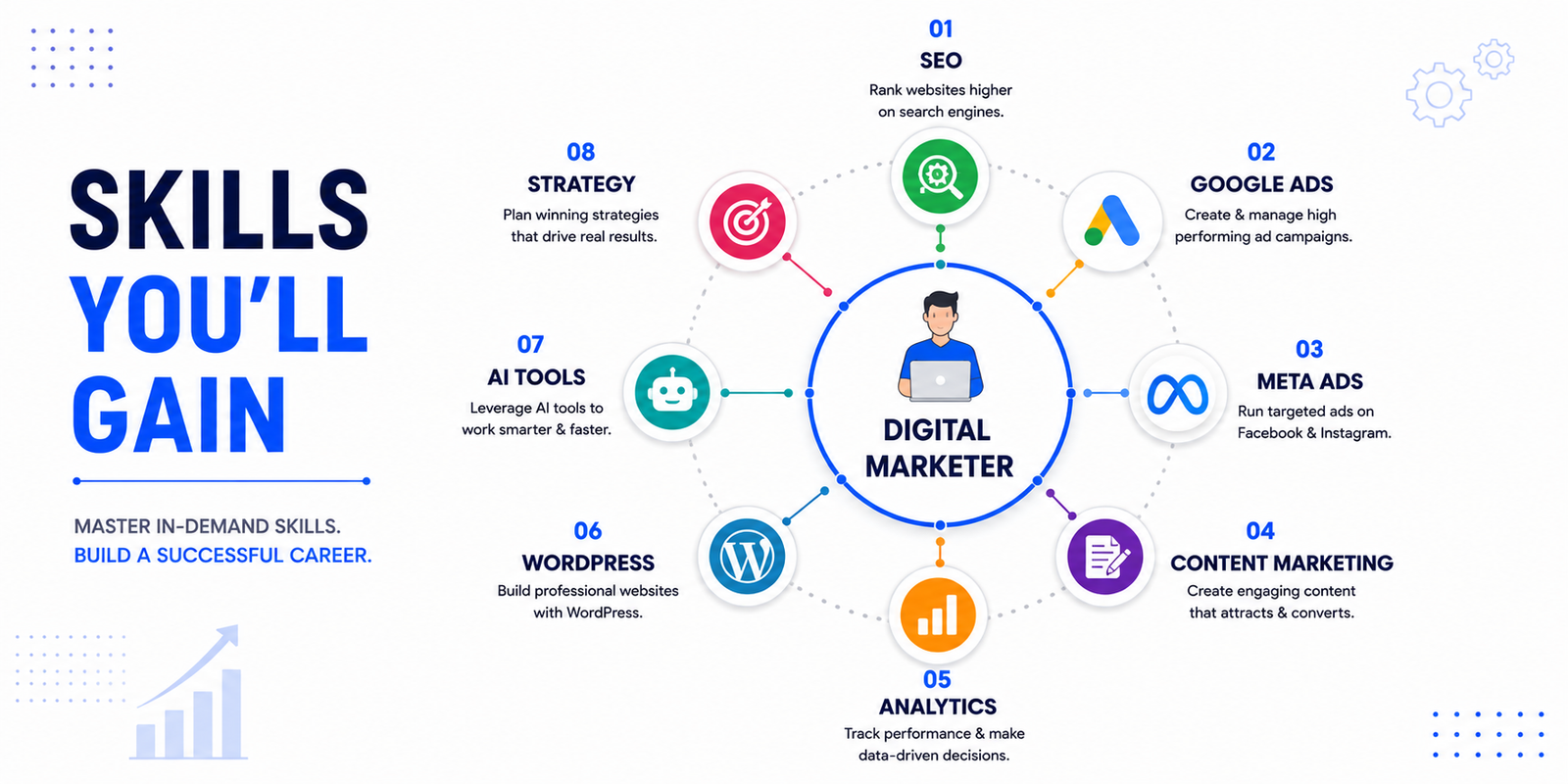
Digital Marketing Skills You Will Gain Infographic - SEO, PPC, Analytics, Social Media & AI Capability Roadmap
Expert Perspective

The digital marketing industry changes every year, but strong fundamentals remain valuable. Professionals who combine marketing knowledge, analytical thinking, communication skills and hands-on experience are generally better prepared for long-term career growth than those who only know how to use a few software tools.

Career Opportunities After Completing a Digital Marketing Course

Popular Digital Marketing Job Roles
Job RolePrimary ResponsibilityBest Skills Required
Digital Marketing ExecutiveManage day-to-day marketing campaignsSEO, Ads, Social Media
SEO ExecutiveImprove website visibility on search enginesSEO, Keyword Research
Google Ads SpecialistPlan and optimise paid campaignsGoogle Ads, Analytics
Social Media ExecutiveManage brand presence across social platformsContent Strategy, Community Management
Content Marketing ExecutiveCreate blogs, landing pages and marketing contentSEO Writing, Content Planning
Email Marketing ExecutiveBuild automated email campaignsEmail Automation, CRM
Web Analytics ExecutiveAnalyse website and campaign performanceGA4, Looker Studio
Performance Marketing ExecutiveImprove paid campaign ROIGoogle Ads, Meta Ads
Freelance Digital MarketerProvide digital marketing services to businessesMultiple Marketing Skills
Where Can You Work?
Digital Marketing Agencies
IT Companies
E-commerce Businesses
Startups
Corporate Marketing Teams
Educational Institutions
Healthcare Organisations
Real Estate Companies
Travel & Hospitality
Freelancing Platforms
Personal Consulting Projects
Career Growth Path

A typical progression trajectory from entry-level to leadership roles:

Intern Executive Specialist Senior Executive Marketing Manager Growth Manager Consultant / Agency Owner
What Influences Career Growth?
Practical project experience
Strong understanding of SEO and paid ads
Ability to analyse campaign data
Continuous learning and adaptation
Portfolio quality
Communication and problem-solving skills
Keeping up with AI tools and industry trends
Expert Perspective

Digital marketing is one of the few industries where practical skills often matter more than academic qualifications alone. Employers increasingly look for candidates who can demonstrate real work through portfolios, projects and measurable results rather than relying only on certificates.

Learn More About Digital Marketing Salaries
Read our detailed guide on Digital Marketing Salary in Kolkata to explore salary ranges, experience-level breakdown, and compensation growth factors.
Read Salary Guide

How to Choose the Right Digital Marketing Course

Start by Understanding Your Career Goal

Before comparing institutes, take a moment to identify why you want to learn digital marketing. A student preparing for their first job, a working professional planning a career transition and a business owner looking to grow online may all require different learning outcomes. Having a clear goal makes it easier to choose a course that matches your expectations instead of selecting one based only on advertisements or discounts.

Important Factors to Evaluate Before Enrolling
1. Check Updated Syllabus

Ensure the course covers modern digital marketing modules rather than outdated basic tactics:

  • SEO & GA4
  • Google Ads
  • Meta Ads
  • Content Marketing
  • AI Tools
  • Marketing Automation
  • Live Projects
2. Prioritise Practical Learning

Verify whether you get hands-on opportunities to implement real marketing tasks:

  • Build websites & optimize live web pages
  • Create & manage Google Ads campaigns
  • Publish SEO blogs & work on analytics
  • Complete portfolio projects
3. Evaluate Trainers' Experience

Learn from industry practitioners who have real project experience and can share actual workflows, challenges, and practical insights rather than theory alone.

4. Compare Industry Tools Included

Get hands-on exposure to essential tools used in everyday industry roles:

  • GA4 & Search Console
  • Google Ads
  • Meta Ads Manager
  • WordPress
  • ChatGPT & Canva
  • Looker Studio
5. Portfolio-Based Learning

Ensure the course helps build a verifiable portfolio for interview readiness:

  • Website Projects
  • SEO Audits
  • Blog Writing
  • Ad Campaigns
  • Analytics Reports
  • Content Calendars
6. Understand Placement Support

Look beyond placement claims and check for concrete career support:

  • Resume preparation & portfolio reviews
  • Mock interviews & interview guidance
  • Internship & job assistance

Compare Practical Learning, Not Just Topics

Two institutes may list similar modules, but the learning experience can be very different. Instead of comparing only the syllabus, look at how each topic is taught. Ask whether students work on real websites, use industry tools, complete assignments and receive feedback from trainers. Practical implementation is often more valuable than simply covering more topics.

Ask Questions Before You Enrol

Before making a decision, consider asking questions such as:

  • Will I work on live projects?
  • Are industry tools included in practical sessions?
  • Will I build a portfolio during the course?
  • Is interview preparation available?
  • How often is the syllabus updated?

These questions help you understand the overall learning experience beyond the course brochure.

Quick Checklist Before You Enrol
Updated 2026 syllabus
Practical assignments
Live projects
Industry-standard tools
AI integration
Portfolio development
Experienced trainers
Interview preparation
Placement assistance
Post-course student support

Real Industry Perspective

A longer course does not always provide better learning, and a shorter course is not necessarily less effective. The quality of practical training, mentor guidance, portfolio development and continuous support usually has a greater influence on career readiness than the duration of the programme alone.

Expert Insight

Many learners compare fees first, but experienced professionals often recommend evaluating the learning process instead. A course that encourages practical implementation, critical thinking and continuous improvement generally provides more long-term value than one that focuses mainly on completing a syllabus.

The best digital marketing course is not necessarily the one with the longest duration or the lowest fees. A well-balanced programme combines updated knowledge, practical implementation, experienced mentors and continuous learning opportunities. Before making a decision, compare multiple institutes and choose the one that aligns with your career goals rather than promotional claims.

Comparing Digital Marketing Institutes?
Read our guide on the Best Digital Marketing Institute in Kolkata to evaluate curriculum, practical training, placement support, and learning methodology.
Read Guide
2026 Digital Marketing Course Learning Timeline
MonthWhat You'll Learn
Month 1Fundamentals + Website + SEO
Month 2Google Ads + Meta Ads + Content
Month 3Analytics + AI + Live Projects
Final WeekPortfolio + Resume + Interview

Frequently Asked Questions (FAQs)

A modern digital marketing course syllabus typically includes SEO, Google Ads, Meta Ads, Social Media Marketing, Content Marketing, Email Marketing, Google Analytics 4 (GA4), WordPress, AI tools, marketing automation, live projects and portfolio development. The exact curriculum may vary depending on the institute, but practical training is an important part of most updated programmes.
Yes. Most digital marketing courses are designed for beginners and start with marketing fundamentals before moving to advanced topics like SEO, paid advertising and analytics. No prior technical background is usually required.
The number of modules depends on the institute, but a comprehensive syllabus generally covers 10–15 core modules along with practical assignments, live projects and industry tools.
Many updated digital marketing courses now include AI tools such as ChatGPT, Google Gemini, Claude, NotebookLM and Canva AI. These tools are commonly used for research, content planning, campaign ideas and productivity, while practical marketing skills remain the foundation.
Most job-oriented digital marketing courses include practical assignments such as website creation, SEO audits, Google Ads campaigns, Meta Ads campaigns, blog writing, analytics reporting and portfolio projects. Practical implementation helps students apply what they learn in real scenarios.
Students are often introduced to tools like Google Analytics 4, Google Search Console, Google Ads, Meta Ads Manager, WordPress, Elementor, Canva, ChatGPT, Google Tag Manager, Looker Studio and other commonly used digital marketing platforms.
Course duration varies depending on the learning format and syllabus. Many institutes offer programmes ranging from 3 to 12 months, with both classroom and online learning options.
After completing a digital marketing course, learners can explore roles such as SEO Executive, Digital Marketing Executive, Google Ads Specialist, Social Media Executive, Content Marketing Executive, Performance Marketer, Web Analytics Executive or Freelance Digital Marketer.
No. Basic digital marketing does not require programming knowledge. However, understanding website structure, HTML basics and WordPress can be helpful for SEO and website management.
Compare the syllabus, practical training, live projects, industry tools, trainer experience, portfolio opportunities, interview preparation and placement support. Choosing a course based on learning quality rather than promotional offers usually leads to better long-term outcomes.
Many learners begin freelancing after gaining practical experience and building a portfolio. Working on real projects during training can help you develop the confidence needed to work with clients.
Digital marketing continues to be an important function for businesses across industries. Professionals who combine practical skills, analytical thinking, content strategy and continuous learning are generally well positioned for career growth as digital channels continue to evolve.
Poulami Dalal - Verified Content Writer & Blog Author

Poulami Dalal

Verified Content Writer & Blog Specialist

Poulami Dalal is a professional content writer with over 3 years of experience crafting SEO-focused blogs, website content, and in-depth informational articles. With strong expertise in search intent mapping and practical digital marketing, her research-backed insights help readers make informed decisions and brands establish long-term online authority.