
What to Check Before Joining a Digital Marketing Institute (2026)
 Written by Poulami Dalal
 Reviewed by Shaheel Khan, Digital Marketing Lead

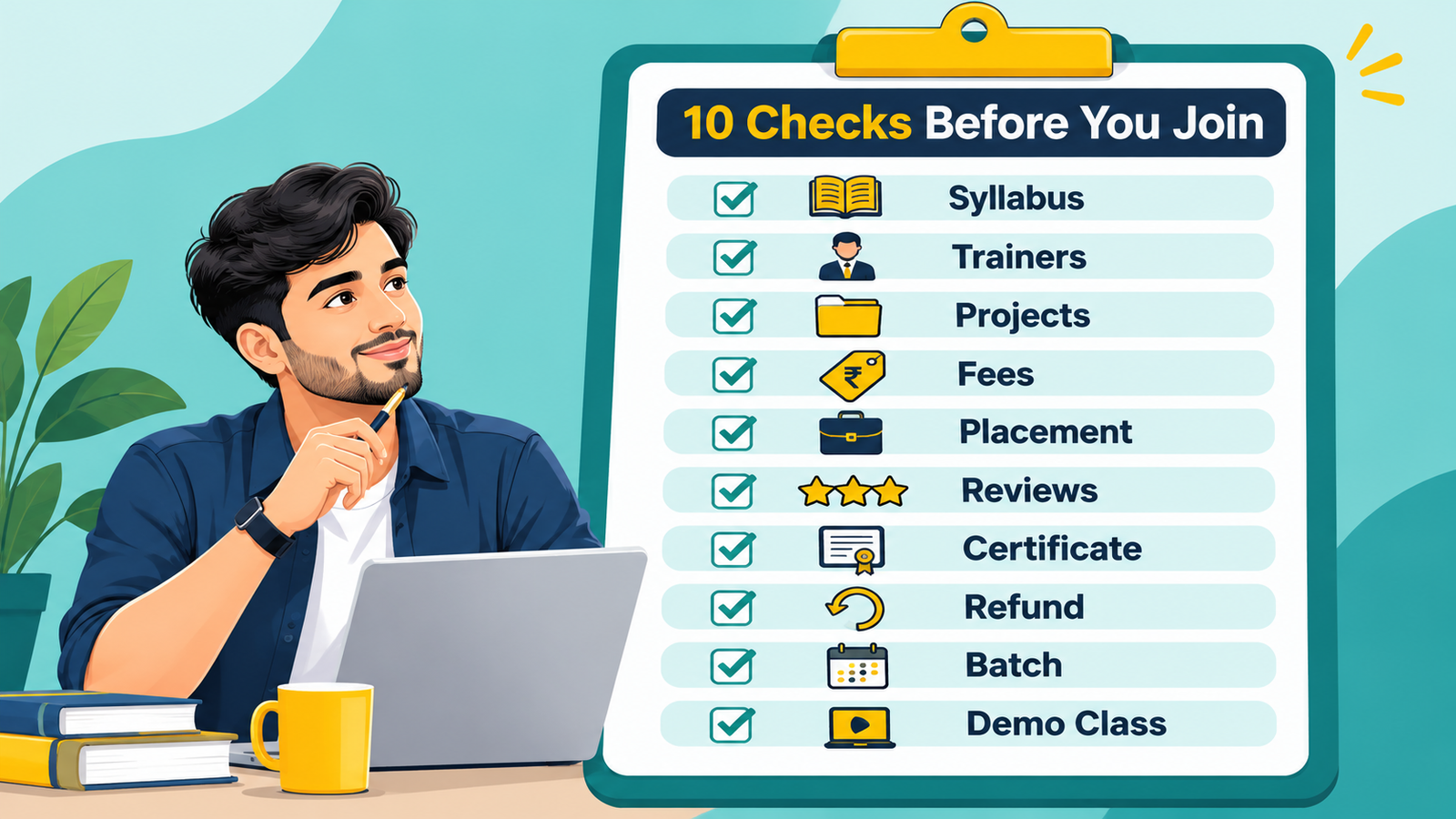
Short answer: before joining a digital marketing institute, check 10 things: an updated syllabus, trainers with real experience, reviewed projects on live tools, the total fee with GST, honest placement support, public Google reviews, a verifiable certificate, a written refund policy, a batch that fits you, and a free demo class.
Joining a digital marketing institute is a bigger decision than it looks. You are investing your money and your time, and the course you pick decides whether you finish with a portfolio or just a certificate. Most students compare institutes only by fees or by the biggest promise on the banner.
This guide gives you a practical checklist of what to check before joining a digital marketing institute, which you can carry on campus visits or phone calls. Use it for any institute, including ours. If you are still comparing options, you can also see how we answer these same questions on our digital marketing course in Kolkata page.
10 things to check before joining a digital marketing institute?
| Check | What to ask |
|---|---|
| Syllabus | Is it updated for AI tools, AI search, GA4 and current ad formats? |
| Trainers | Who will teach my batch, and what have they actually worked on? |
| Projects and tools | How many projects will I finish, and on which tools? |
| Fees | What is the total, including GST, registration and EMI charges? |
| Placement | What exactly is included, and can I verify students who were placed? |
| Reviews | What do the critical Google reviews say? |
| Certificate | Can an employer verify it online? |
| Refund | What are the conditions, in writing? |
| Batch and mode | Class timing, weekly hours, language and online option? |
| Demo | Can I attend a class and meet the trainer before I pay? |
What to check before joining a digital marketing institute: the full checklist
1. Check whether the syllabus is current
Digital marketing changes every year. Google adds new campaign types, Meta changes how its ads are targeted, and AI tools and AI search now sit inside everyday marketing work. A syllabus that stops at basic SEO, basic Facebook ads and a Canva session is out of date.
Ask for the week-by-week syllabus, not the brochure summary. A modern course should cover strategy, SEO and local SEO, social media and short-form video, Google Ads and Meta Ads, analytics and reporting (GA4, Google Tag Manager, Looker Studio), content, email and WhatsApp marketing, website and landing page basics, and AI tools for marketing. You can compare against our own digital marketing course syllabus to see what a detailed module list looks like.
Ask the institute
- Can I get the full syllabus in writing before I pay?
- When was it last updated, and what changed?
- Is there a module on AI tools and on getting found in AI answers (AEO and GEO)?
Red flag: a syllabus that is only a list of tool names with no topics, hours or projects under each.
2. Check who will actually teach you
The trainer matters more than the brochure. Ask for the name of the person teaching your batch, look them up on LinkedIn, and ask what campaigns, websites or clients they have worked on. Someone who has run ad accounts and audited websites teaches differently from someone who has only read about them.
Also ask whether the trainer can change during the course. Trainers do change between batches at many institutes, so it is fair to ask who will take your classes and to meet them first.
Ask the institute
- Who teaches my batch, and can I meet them before joining?
- How many years of hands-on work do they have in SEO, ads and analytics?
- Do they review my assignments, or are classes only lectures?
Red flag: the institute cannot name the trainer, or says you will find out after admission.
3. Check the projects and the tools you will use
Employers and clients ask to see your work. A certificate alone rarely answers that. Look for a course where you finish several projects based on real business briefs, such as an SEO audit, a Google Ads search campaign, a Meta lead campaign, a GA4 report, a content calendar and a final strategy deck, and where a trainer reviews each one.
Then ask about the tools. Practising on real tools such as Google Ads, Meta Ads Manager, GA4, Search Console and an SEO tool like Semrush or Ahrefs is very different from watching a demo on a projector. Ask whether you will get hands-on access or only a trainer walkthrough.
Ask the institute
- How many projects will I complete, and who reviews them?
- Will I work on live tools myself in class?
- Can I see projects from a previous batch?
Red flag: “live projects” promised but no sample, no brief and no reviewer.
4. Check the full fee, not just the headline number
Fees are where many students get surprised. Ask for the total you will actually pay: the course fee, GST on top, any registration or seat booking amount, exam or certification charges, and any extra for internships or advanced modules. If you choose EMI, ask whether there is interest or a processing fee.
Transparent institutes publish their fees. For example, our digital marketing course fees in Kolkata are listed openly: ₹30,000 + GST for the 4-month program, ₹50,000 + GST for the 6-month program and ₹80,000 + GST for the 12-month program with internship. Whichever institute you choose, compare like with like: same duration, same modules, same number of projects. For a full breakdown of GST, exam fees and hidden costs, read our guide on what changes the price of a digital marketing course.
Ask the institute
- What is the total amount including GST and every other charge?
- Is the fee the same for classroom, online and hybrid?
- Are there separate charges for internship, exams or study material?
Red flag: a “limited-time discount” that forces you to pay the same day, or fees shared only after you give your phone number.
5. Check what “placement” really means
No institute controls an employer’s hiring decision, so a promise of a guaranteed job should make you careful. What a good institute can honestly offer is placement support: resume and LinkedIn help, portfolio review, mock interviews and openings shared by a placement team.
To test the claim, ask for names of students who were placed, the roles they got and the companies. Look them up on LinkedIn. Real placements can be verified in a few minutes. You can see how this looks in practice on our placement support page.
Ask the institute
- What does placement support include, step by step?
- Can I speak to or look up recently placed students?
- Does placement support start before the course ends?
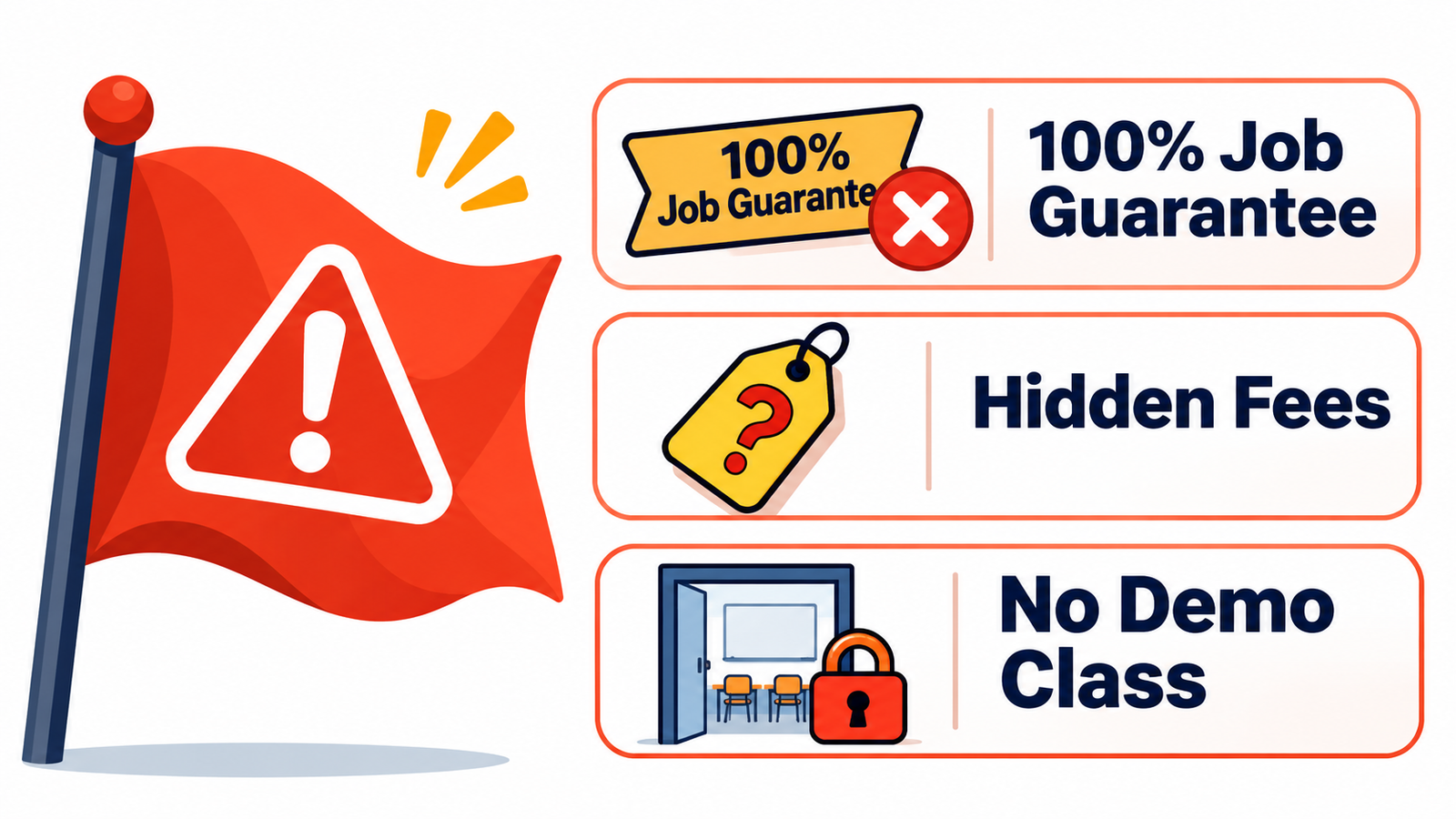
Red flag: “100% job guarantee”, or placement numbers that cannot be traced to real people.
6. Read the reviews yourself
Do not rely on the testimonials an institute selects for its own website. Open its Google Business Profile and read the reviews directly, including the low ratings. Look at how many reviews there are, whether they mention a trainer or a specific module, and how the institute replies to complaints.
A few critical reviews are normal. What matters is whether the complaints repeat (for example, about refunds or cancelled classes) and whether the institute responds honestly. You can read what students say about us on our student reviews page and on Google.
Red flag: only a handful of reviews that all sound alike, or no way to see the reviews on a public platform.
7. Check that the certificate can be verified
A certificate matters only if someone can confirm it is real. Ask whether each certificate carries a unique code and whether employers can check it online. Also ask which certificates the institute itself issues and which ones come from Google, Meta or HubSpot, because those exams are run by the companies, not by the institute. See how we handle this on our certificate verification page.
Red flag: an institute that implies its own certificate is a Google or Meta certification.
8. Read the refund policy before you pay
Most students never read the refund policy, and most regret it only when plans change. Ask for the policy in writing and note the time limit, the number of classes after which a refund stops, and which fees are non-refundable. Our own refund policy is conditional and time-limited, so read any policy fully, ours included.
Red flag: a verbal promise of a refund that is not written anywhere.
9. Check the batch, schedule, mode and language
A course only works if you can attend it regularly. Check the class days, session length, weekly hours, weekday and weekend options, and whether an online or hybrid option exists if you cannot always travel. If you are more comfortable in Hindi or Bengali, ask which language classes are taught in. Working professionals should ask about evening and weekend batches. If you are unsure about the format, read our guide to online vs offline digital marketing courses.
Ask the institute
- How many classes a week, and how long is each?
- Is there a recording or make-up option if I miss a class?
- Which language mix is used in my batch?
10. Attend a demo class and visit the campus
This is the most reliable check of all. Sit in on a class, watch how the trainer explains a topic, see how many students are in the room and whether people are working on real tools. Ask a technical question and notice whether you get a clear answer.
If an institute offers a free demo, use it. If it does not allow a demo or a campus visit, treat that as information. You can book a free demo class at our Dum Dum campus or online and judge us by the same checklist.
Want a hands-on test to run during the demo? Use the campaign test in our guide to the best digital marketing institutes in Kolkata.

What are the red flags of a bad digital marketing institute?
- A guaranteed job or a guaranteed salary.
- Fees hidden until you share your number, or pressure to pay today.
- No named trainer and no demo class.
- A syllabus with tool names but no topics, hours or projects.
- “Live projects” with no sample work to see.
- Refund promises that are not in writing.
- Certificates presented as if they came from Google or Meta.
- Reviews that are all one sentence long, or hidden from public view.
How do you compare digital marketing institutes? Use this scorecard
Visit or call two or three institutes, then fill in this table. Score each row from 1 to 5. The institute with the strongest answers on projects, trainers and honesty usually beats the cheapest one.
| Check | Institute A | Institute B | Institute C |
|---|---|---|---|
| Updated syllabus (AI, GA4, ads) | |||
| Named, experienced trainer | |||
| Number of reviewed projects | |||
| Total fee including GST | |||
| Honest placement support | |||
| Public Google reviews | |||
| Verifiable certificate | |||
| Written refund policy | |||
| Batch, mode and language fit | |||
| Free demo class |
How W3 Web School answers these questions
We would rather you check us than trust us, so here are the facts you can verify on our digital marketing course in Kolkata page:
- Teaching since 2012 from our Dum Dum campus, with ISO 9001:2015 certification.
- Three programs (4, 6 and 12 months) with fees shown on the page, before GST.
- The 6 and 12-month programs cover all 10 modules, including AI marketing, AEO and GEO, and all 8 portfolio projects.
- Placement support in every program, with no job guarantee.
- Certificates that employers can verify online.
- A free 1-hour demo class at the campus or online.
- A 4.8 rating on Google from 420+ reviews, which you can read yourself.
If you are exploring other options such as shorter, single-skill courses or learning from outside Kolkata, our live online digital marketing course follows the same approach.
Frequently asked questions about joining a digital marketing institute
How do I choose the best digital marketing institute in Kolkata?
Compare the full syllabus, the trainer’s real experience, the number of reviewed projects, the total fee including GST, the refund policy and what placement support includes. Then attend a demo class and ask to see student work before you pay.
What questions should I ask before joining a digital marketing course?
Ask who teaches your batch, how many projects you will complete, what the total fee is including GST, what placement support covers, whether the certificate can be verified, what the refund conditions are and whether a free demo class is available.
Is a job guarantee from a digital marketing institute real?
Be careful with it. The employer makes the hiring decision, so no institute can honestly control the outcome. Look for institutes that offer clear placement support instead: resume and LinkedIn help, portfolio review, mock interviews and openings shared by a placement team.
How much does a digital marketing course cost in Kolkata?
Fees vary by institute, duration and syllabus. Always ask for the total including GST and any extra charges. At W3 Web School the programs are ₹30,000, ₹50,000 and ₹80,000 plus GST for 4, 6 and 12 months respectively, as listed on our course fees section.
Do I need a demo class before taking admission?
It is strongly recommended. A demo class lets you meet the trainer, see how classes run and ask questions about the syllabus and batches before you spend any money.
Can I learn digital marketing without a marketing degree or coding knowledge?
Yes. Digital marketing work such as SEO, ads, social media and analytics is done with tools, not code. You need basic computer skills and time to practise between classes. Our digital marketing course eligibility guide explains who can join.
Should I choose a 4, 6 or 12-month digital marketing course?
It depends on your goal. A shorter program suits business owners who need the core skills quickly. A longer program with more modules and projects suits freshers and career changers who want a complete skill set and a portfolio. Compare the number of modules and projects, not just the duration.
How do I know if a digital marketing institute is good?
A good institute shows you its full syllabus, names the trainers, lets you attend a demo class and can show real student work such as campaign reports or websites. It also gives fees, GST and the refund policy in writing, and it does not promise a guaranteed job.
Are digital marketing courses worth it?
They can be, if the course gives you hands-on practice on real tools, feedback from a trainer and a portfolio. If you only want to understand marketing for your own business, free resources from Google and Meta may be enough. Judge a course by the practice and feedback you get, not by the certificate.
What should a digital marketing course syllabus include?
A complete syllabus covers marketing fundamentals, WordPress, SEO, Google Ads, Meta Ads, social media, content, email, Google Analytics 4, video and AI tools, with a project in each module. See our digital marketing course syllabus for a module-by-module list.
Is a Google or Meta certificate enough to get a digital marketing job?
Usually not on its own. Certificates show you know the basics, but employers also look for a portfolio and real campaign or SEO work they can ask you about. Google’s foundational certifications are free, so take them alongside practical projects.
What is the difference between placement assistance and a job guarantee?
Placement assistance means the institute helps with resume review, mock interviews and openings it knows about. A job guarantee promises you a job, which no institute can honestly control because the employer makes the final decision. Prefer clear support steps over big promises.
How can I check that an institute’s placement claims are real?
Ask for the names, roles and companies of recently placed students and look them up on LinkedIn. Ask how long they took to get hired and what support they received. Real placements are easy to verify, while vague percentages are not.
How do I know if an institute’s Google reviews are genuine?
Open its Google Business Profile and read the reviews yourself, including the low ratings. Genuine reviews usually mention specific trainers, modules or experiences, arrive over a long period and get replies from the institute. Many near-identical short reviews posted together are a warning sign.
Should I pay the full course fee upfront?
Ask first whether instalments are available, and get the payment schedule and refund policy in writing before you pay anything. Avoid pressure to pay the same day for a “discount”. Our course page lists current fees and instalment options.
How do I compare two digital marketing institutes?
Compare them on the same points: updated syllabus, trainer experience, number of reviewed projects, total fee including GST, placement support, refund policy and batch format. Score each from 1 to 5 using the scorecard in this guide, and attend a demo class at both.
Is a demo class free, and what should I check in it?
Many institutes offer a free demo class, so ask before you pay anything. Check how the trainer explains a topic, whether students work on real tools, how many people are in the room and whether your questions get clear answers. You can book a free demo class with us.
Is an online or a classroom digital marketing course better?
Live online classes with regular trainer feedback can work as well as classroom batches, while recorded-only courses give little feedback. Classroom suits learners who like face-to-face doubts, and online suits working professionals. Read our online vs offline digital marketing course comparison.
Can I join a digital marketing institute with no marketing background?
Yes. Most institutes accept learners after Class 12 from any stream, and coding is not required. Check that the batch suits beginners and ask the trainer how the course starts, so you are not lost in the first week.
What is the eligibility for a digital marketing course?
Most institutes accept learners after Class 12 from any stream, as well as graduates, working professionals and business owners. You need basic computer skills and internet access, and no coding. Our digital marketing course eligibility guide explains who can join.
How long does a digital marketing course take?
Most digital marketing courses take 3 to 6 months. Short courses run 1 to 2 months, and programs with an internship can run 6 to 12 months. Compare total class hours and projects, not just months. See the digital marketing course duration guide.
Is a 3-month digital marketing course enough to get a job?
It can be enough for the core skills if the course has enough class hours, real projects and trainer feedback, and you practise between classes. For a first job, a 4 to 6-month program usually leaves more time for projects, a portfolio and interview practice.
What hidden costs should I check besides the course fee?
Ask whether the quoted fee includes GST, exam or certificate fees, study material, tool subscriptions and ad spend for practice campaigns. Get the total in writing before you pay. Our digital marketing course fees guide explains what changes the price.
What should a digital marketing institute’s refund policy say?
It should state in writing the period in which you can ask for a refund, what share of the fee is returned, what is not refundable and how long the refund takes. If an institute will not share its refund policy before you pay, treat that as a warning sign.
How many live projects should a digital marketing course include?
There is no fixed number, but a job-ready course should have a project in every major module, such as SEO, Google Ads, Meta Ads, email and analytics, with a trainer reviewing each one. Ask to see past student projects. At W3 Web School, the 6 and 12-month programs include all 8 portfolio projects.
Which tools should a digital marketing course teach?
A current course should give you hands-on practice with Google Ads, Meta Ads, Google Analytics 4, Google Tag Manager, Google Search Console, WordPress, an SEO tool and AI marketing tools. Check that you will use the tools yourself, not only watch the trainer. The digital marketing course syllabus lists the modules in detail.
How can I verify a digital marketing course certificate?
Ask whether the institute has an online certificate verification page where an employer can enter your certificate number. Also check who issues the certificate and whether it is signed by the institute. A certificate that cannot be verified adds little value to your resume.
Can I join a digital marketing course while working or studying?
Yes. Many institutes run weekday, evening or weekend batches, and live online classes help if you cannot travel. Ask for the exact batch timings, what happens if you miss a class and whether recordings or backup sessions are available. Plan for about 6 to 10 hours a week including practice.
What are the signs of a fake or unreliable digital marketing institute?
Common warning signs are a 100% job guarantee, pressure to pay the same day for a discount, no named trainers, no demo class, a syllabus without GA4 or tracking, and reviews that look copied. Our red flags list above covers more.
Is digital marketing a good career in Kolkata?
It can be, because local businesses, agencies and e-commerce brands need people who can run SEO, ads and social media and report results. Your chances depend on your portfolio and practical skills, not the certificate alone. Read our guide on whether digital marketing is a good career in Kolkata.
How much can a fresher earn in digital marketing in Kolkata?
Pay varies by role, company, skills and portfolio, so be careful with any institute that quotes a fixed salary. Look at current job listings for the roles you want and read our digital marketing salary in Kolkata guide for what the data shows.
Conclusion: What to Check Before Joining a Digital Marketing Institute
Now you know what to check before joining a digital marketing institute: an updated syllabus, trainers who have done the work, reviewed projects on real tools, the full fee including GST, honest placement support, reviews you have read yourself, a verifiable certificate, a written refund policy, a batch that fits your life and a free demo class. An institute that answers all ten clearly and in writing deserves a place on your shortlist. One that avoids them is telling you something too.
Do not decide on fees or on the biggest promise alone. Visit two or three institutes, fill in the scorecard above, sit in on a demo class and then choose the one that shows you real student work. The right course gives you skills you can demonstrate, not just a certificate to frame.
If you want to check us against this list, read our digital marketing course in Kolkata page for the syllabus, fees and batches, and book a free demo class to ask us every question from this guide.
Related readings
-
 Best Digital Marketing Institutes in Kolkata: 6 Compared, With a Campaign Test
Six institutes compared, plus a test to run in any demo class.
-
 10 Best Digital Marketing Institutes in Kolkata (2026): Fees, Courses & Comparison
A side-by-side table of format, duration, fees and career support.
-
 How Much Does a Digital Marketing Course Cost? What Changes the Price
GST, exam fees, tools and hidden charges explained.
-
 Digital Marketing Course Syllabus (2026): Modules, AI Tools, Live Projects & Skills
What a modern syllabus should cover, module by module.
-
 Digital Marketing Course Duration (2026): How Long Does It Take to Complete?
Typical course lengths and how to pick one for your goal.
-
 Digital Marketing Course Eligibility: Who Can Learn Digital Marketing
Who can join after 10th, 12th or graduation.
-
 Digital Marketing Salary in Kolkata: What the Data Shows and How to Earn More
What affects pay and how to grow your earnings.
-
 Online vs Offline Digital Marketing Course: Which Is Better?
Pros, cons and a quick comparison of both formats.
See us against your checklist
Visit our Dum Dum campus or join online for a free 1-hour demo class. Bring this checklist and ask us anything.