How to Rank in AI Overview for Better Visibility in 2026

Are you ready to rank in AI overviews with AI SEO mastery? Google Search is rapidly evolving, and you can notice the biggest changes in AI overviews. It now generates AI summaries of search queries with trusted website citations, instead of showing on blue links! This transformation has changed the way marketers, SEO professionals, and businesses work on search optimization.
If you are thinking about how to rank in AI Overviews, you are not the only one. Websites are now competing for visibility and organic traffic in Google’s AI answers, as an appearance on an AI overview can boost quality traffic, brand authority, and trust.
In this article, I will discuss how to rank in AI overviews, the best practices, the importance of AI ranking, the difference from traditional ranking, and actionable strategies for higher visibility in 2026. If you are a business owner, SEO professional, student or digital marketer, these proven strategies will help you get higher rankings in AI search.
Master AI SEO & Digital Marketing Skills 🚀
Learn SEO, Google Ads, AI Marketing, Social Media Marketing, Performance Marketing, and live industry projects with expert trainers.
Explore Course →
What is AI Overview?
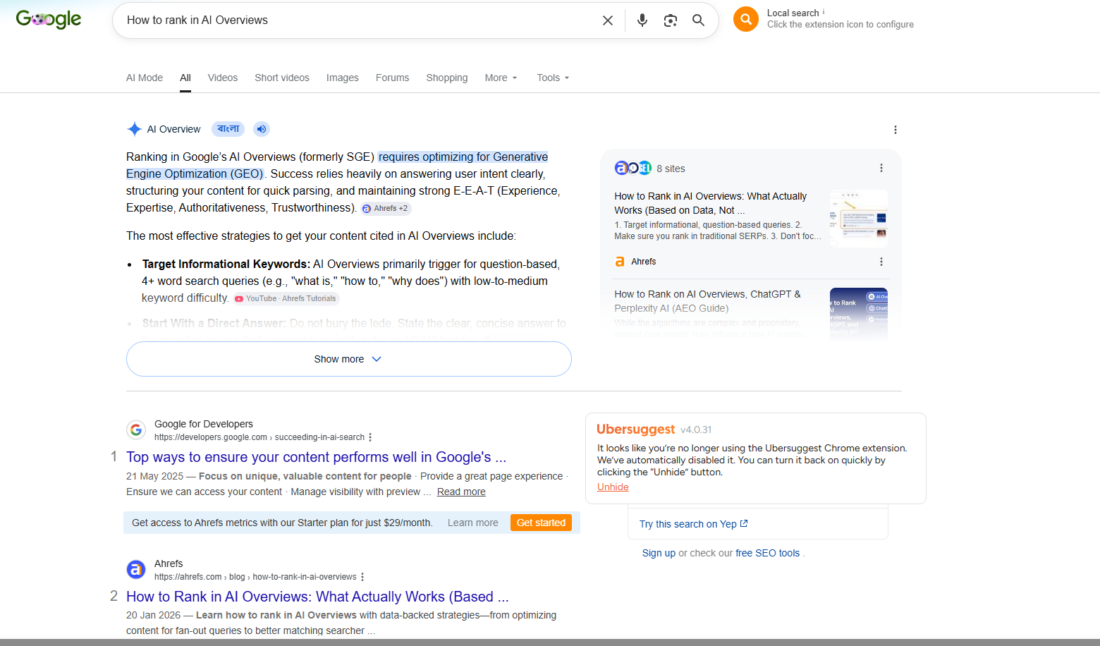
AI Overview refers to Google’s AI-generated search feature that offers user with instant and detailed answers on search results pages. You don’t need to visit different websites to get an answer. Google’s advanced AI model summarises information from credible sources into a response.
Featured snippets only show a small portion of data from one webpage, but AI overviews gather data from different trusted sources and generate more detailed answers. The websites that are cited in the AI-generated answers get higher visibility, trust, credibility and chances to capture quality traffic.
AI overview has become increasingly important for businesses and digital marketers, just like getting first position in traditional search results. If the content is well-structured, clear, user-friendly, and follows EEAT signals, then there might be higher chances that Google will reference you in the AI-generated answers.
What is the Importance of AI Ranking for SEO in 2026?
AI rankings are reshaping the new search behaviour. Users highly depend on AI answers as they are quick and summarised versions, and you don’t even need to visit multiple pages. Websites get citations in AI overviews, and this leads to higher visibility, authority, and brand awareness.
Some benefits of AI rankings are;
- Higher visibility than traditional organic search results.
- Increase trust with AI-generated references.
- Improved brand authority within your industry.
- More qualified traffic from higher search intent users.
What is the Difference Between AI Ranking and Traditional Ranking?
The ranking process has been drastically improved; however the AI overviews are based on traditional SEO principles. Traditional SEO is based on backlinks, relevant keywords, and technical optimization to boost rankings on search engine result pages. AI rankings highlight user intent, topical authority, quality of content, and credibility.
| Ranking Factors | AI Ranking | Traditional Ranking |
|---|---|---|
| Main Goal | Trusted AI Source | Ranking on Web Pages |
| EEAT | Must | Recommended |
| Search Intent | Crucial | Vital |
| Semantic SEO | Very Important | Helpful |
| Entity Optimization | Crucial | Not Essential |
| Content Freshness | Must & Very Important | Essential |
| Structured Data | Must-Essential Ranking Signal | Vital |
Google AI analyses if your content genuinely answers user queries, shows expertise, and offers unique value. Targeting keywords only is not enough. Making user-focused and helpful content is the key to higher search performance.
How Does Google Select Which Content Appears in AI Overview?
If you know how Google decides content for AI overviews is the first step to understanding how to rank in AI overviews quickly. AI overviews depend on different quality signals to decide if a webpage is credible enough to cite in AI search answers.
Google’s AI don’t go for pages with higher keyword density; rather, it analyzes credibility, relevancy, and any user-first approach of your content before adding it to AI search responses.
Helpful & Quality Content
Google prioritizes helpful and quality resources over thin and duplicate content. High-quality content must include comprehensive guides, tables, statistics, definitions, FAQs, real-world examples, expert tips, and more. The more relevant resources you add, the higher the chances are that AI will cite you as a trusted source.
Semantic Search
Google not only understands keywords, but it also comprehends topics. Rather than repeating the same keyword, you can add related search terms like AI search, AI SEO, Google AI search, AI rankings and more naturally. This semantic keyword usage helps Google understand the context of your content.
Fresh Information
AI search prioritizes updated or fresh content. Just add the latest examples, trends, statistics, and current Google updates. You can also add a “last updated” date to build readers’ trust.
Search Intent
You must match the user’s intent with your content, as it is one of the important ranking factors. Ensure that your content answers the question completely, is easy to understand, and solves user problems or queries.
For example, if someone searches for “How to rank in AI Overview”, they might be looking for strategies or best practices, not just a simple AI overview definition.
EEAT Signals
Google checks Experience, Expertise, Authoritativeness, and Trustworthiness (EEAT) in content. You can boost EEAT signals by just adding real examples, case studies, author bio, credible sources, statistics, and professional experiences.
Websites that highlight real stats and examples get the higher probability of appearing on AI Overview.
What Factors Affect AI Ranking?
If you want to know how to rank in AI Overview, then you should know how to optimize for various ranking signals rather than just prioritizing keywords only.
Below are some most vital factors that affect AI rankings in 2026.
Page Speed & Experience: A fast and mobile-responsive website leads to a better user experience. You need to focus on responsive design, HTTPs security, fast page loading speed, easy navigation, and core web vitals.
Search Intent Optimization: The content should fulfill one clear search intent. It must align with what your potential audience wants.
Content Quality: Make well-researched, original and structured content that truly solves user queries.
Internal Linking: Connect relevant articles naturally with strategic internal linking. This will help Google comprehend the topical relationships of your website.
Topical Authority: Try publishing different articles under the same niche to create topical authority.
Schema Markup: Schema markup helps search engines understand your content better. You must target schema types like FAQs schema, organization schema, article schema, breadcrumb schema, and author schema. This boosts readability and your chances of getting AI citations.
Images and Videos: Stop using stock images; rather, use real screenshots, charts, custom infographics, comparison tables, and process diagrams. Appealing images and videos lead to higher engagement and improved content quality.
How to Rank in AI Overviews: A Step-by-Step Guide
This is the prime part of this article. If you want to boost search visibility and get a chance to be cited on AI answers, then you require a structured plan, not just old SEO tactics.
Here, the best strategies to rank in AI overviews are clearly explained.
Topical Authority Building
Continuously publishing high-quality content in a specific niche helps you earn Google’s trust. You need to make a complete content ecosystem on different related topics. The more detailed and understandable your topical knowledge is, the higher your authority becomes.
Knowing Search Intent
Before making content, you need to find out what your potential users are searching for. If you take “How to rank in AI overview” as an example, then your user might look for;
- Actionable techniques or practices
- Real-life examples
- Ranking factors
- AI SEO Strategies
Your content must answer all the queries easily rather than just focusing on definition.
Using Semantic Keywords
AI overviews depend highly on semantic keywords to display relevant information fast. Try to add synonyms, related topics and keywords to improve relevancy and chances to appear on multiple search intents. According to Tripledart, using long-tail keywords helps your content align properly with AI contextual understanding. This gives the best matching results.
Enhance E.E.A.T. Signal
AI overviews sites links from credible sources that Google thinks authoritative. That’s why you need to improve your EEAT signals. You need to focus on some areas, and they are;
- A well-researched, accurate, and insightful content. Always mention who verified the sources.
- Always demonstrate author expertise and qualifications by adding an author profile on the website, or with a short author bio.
- According to SE Ranking, you need to highlight your brand expertise with active industry engagement. You need to manage continuous social media visibility with popular social media platforms like Planable.
Make Using People-First Approach
Google’s AI overview focuses on content that is created using the People-first approach. According to the Google Search Central Blog, rather than publishing short content that focuses on keywords only, make detailed content that fulfills people’s needs. Make unique, reliable, and helpful content that satisfies users.
Internal Linking Optimization
Internal linking helps Google understand your website’s topical authority and content hierarchy. For example, this article should be linked to related content such as a digital marketing course, a technical SEO guide, a PPC course, an SEO course, a content marketing guide, and a performance marketing guide.
These internal links enhance user experience, navigation, and higher topical authority.
Include Schema Markup
Schema markup helps search engines explain your content more precisely. For example, this blog must implement FAQs schema, organization schema, article schema, author schema, and breadcrumb schema. It boosts your content’s readability and chances of being chosen.
UX Enhancement
Google prioritizes websites that offer a great user experience. The best practices cover: easy-to-read typography, mobile responsiveness, fast-loading speed, easy navigation, short paragraphs, and visual elements.
A satisfying user experience boosts engagement metrics like time on page and bounce rate reduction.
Frequently Update Content
AI search prioritizes content that gives the latest information. Update your content frequently by adding the latest Google updates, statistics, additional sections, examples, screenshots, and also removing outdated information from the content.
Showing a “Last Updated” date also gives users the freshness signal.
Mistakes that Prevent AI Overview Rankings
Most of the websites face difficulty in appearing in AI overviews because of some mistakes. Those mistakes are;
- Keyword stuffing
- User intent ignoring
- Thin content publishing
- Poor backlinks and internal links
- Failed structured data implementation
- Ignoring E.E.A.T. signals
- Using outdated sources
- Creating AI-generated content without human edits
- Poor page experience
- Lack of relevant and real examples
Future of AI Search in 2026
AI search is continuously changing with new updates in multimodal search, conversational experiences, natural language processing, and custom suggestions.
The future trends in AI search are;
- Higher implementation of entity-based search.
- Higher importance on topical authority.
- More customized AI-powered responses.
- Growth in conversational and voice search.
- Better integration of multimedia and visual content.
Master SEO, Google Ads, Social Media, AI Marketing, and Analytics through practical training, live projects, and dedicated placement support.
Explore Course →FAQs on How to Rank in AI Overview
The factors affecting AI ranking include EEAT signals, structured and helpful content, scannable content, topical authority, and content depth. EEAT has become one of the most vital factors after the December 2025 Core Update.
It takes around 6 to 8 weeks after content publishing to see citation changes. If you want to get results faster, you need to add author bio, FAQ schema, and topical clusters.
The popular tools that help with AI rankings include ChatGPT, Google Trends, Google Search Console, SEMrush, Schema Markup Generator, PageSpeed Insights, Ahrefs, and Surfer SEO.
No, it is not. SEO ranking focuses only on boosting rankings on organic searches, whereas AI ranking focuses on making your content appear on citations and AI summaries. AI rankings put emphasis on topical authority, content quality, semantic knowledge, and EEAT.
You can boost your chances by generating in-depth content, including FAQ schema, building internal links, structured headings, showing EEAT, boosting page speed, and keeping the latest content updates.
The queries that trigger AI overviews frequently are;
- Informational
- How-to
- Question-based answers
- Location-specific questions
- Transactional queries
Final Thoughts,
AI overviews help you enhance your search engine visibility and rankings. You need to optimize your content strategically to get the chance of appearing on AIOs at the top of the search engine results. Google AI mention help you drive traffic to your website and boost brand awareness and trust.
So, don’t miss the chance to appear and rank in AI overviews. The abovementioned proven strategies help you achieve AI rankings.
If you want to learn advanced SEO techniques, Google AI overviews, AI search optimization, content marketing, and AI-powered digital marketing strategies, W3 Web School’s AI-Integrated Digital Marketing Course in Kolkata offers the best hands-on training, real-client projects, job assistance, and career guidance.