Get clear, honest guidance based on real industry experience — no sales calls, just the right direction.
Digital Marketing Funnel: Stages, Importance & How to Create One
Last updated: January 2026 | Updated for 2026 Digital Trends
Are you failing to convert visitors into leads even after getting higher website traffic? Your business fails to generate consistent leads despite spending on social media, SEO, and ads? This might happen when you don’t have a proper system to guide users through their buyer’s journey after they land on your website.
Without a well-structured plan, visitors become confused, frustrated, and lost, and finally leave your website without taking any desired action. This wastes both of your time and marketing budget. Here, the digital marketing funnel comes in. It guides users in their journey from brand awareness to retention.
In this guide, I will discuss what a digital marketing funnel is, its different stages, its importance, types, how to create one that converts, and mistakes to avoid.
Let’s get started.
Become a Digital Marketing Expert
Master SEO, paid ads, social media, funnels & analytics with a job-ready Digital Marketing Course.
Explore Course →
What is Digital Marketing Funnel?
Digital Marketing Funnel is a strategic approach that helps businesses visualize their potential customers’ journey from watching the ad as the first interaction to completing a purchase as the final conversion. This visual journey explains how customers react at different stages before making a purchase. This is also known as the Digital Marketing and Sales Funnel.
In simpler words, a funnel in digital marketing helps.
- In attracting the right audiences.
- In nurturing their problems and interests.
- In turning them into loyal customers.
- In retaining them for longer periods.
Digital marketing funnels are data-focused. They track user behaviour and use targeted content to help users according to their specific interests.
What are the Digital Marketing Funnel Stages?
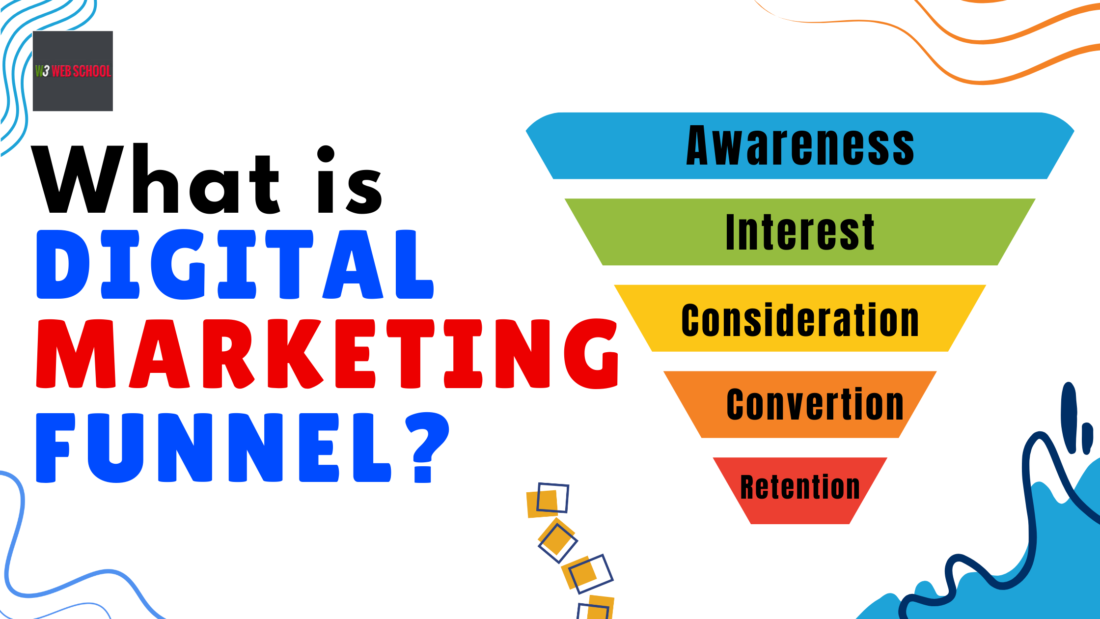
Having a clear idea of the Digital Marketing Funnel stages will help you create exclusive content, ads, and marketing campaigns that match the user intent. I have discussed the five important stages below;
Stage 1: Awareness Stage
The awareness stage is located at the top of the funnel. Here, users get aware of your brand. They have no idea about your product or services yet. The goal of this stage is to attract the attention of audiences by creating strong visibility.
Popular channels used:
- Google search
- YouTube videos
- Social media ads
- Blogs
Stage 2: Interest Stage
The next stage is the interest stage, where users have brand awareness and want to know more details. First, users engage with your appealing content and then explore different solutions. The main goal is to boost interest and build trust.
Popular Strategies used:
- Email newsletter
- Lead magnets like checklists and free guides
- Educational blogs
- Social media engagement
Stage 3: Consideration Stage
It is the third stage of the funnel where users can compare multiple brands and analyze options before making any final decisions. The goal is to highlight your brand as the best possible solution to user problems.
Popular content used:
- Guides and testimonials
- Case studies
- Webiners
- Product comparisons
Stage 4: Conversion Stage
This stage leads users to take a desired action like signing up, booking a call, or making a purchase. The prime goal is to convert leads to loyal customers.
Major elements used:
- Limited-time deals
- Landing pages
- Powerful CTAs
- Optimized checkouts
Stage 5: Retention Stage
The final stage is retention, which is focused on making customers engaged and repeat purchases. The goal is to establish long-term, successful customer relationships.
Retention strategies used:
- Upselling and cross-selling
- Remarketing ads
- Email marketing
- Different loyalty programs
Why is the Digital Marketing Funnel Important?
A digital marketing funnel helps to create a structured approach for lead generation and conversions instead of depending on any marketing strategies.
- Organized segmentation: A digital marketing funnel helps you get more organised segmentation of marketing strategies and activities. This allows you to offer perfect content to customers at each stage of the buyer’s journey.
- Boosts customer experience: This funnel helps businesses deliver the right message at the right time, thereby improving the customer experience.
- Finding out ineffective marketing strategies: It helps in identifying poor marketing strategies through analyzing user drop-offs at each stage.
- Higher conversion rates: This funnel guides audiences smoothly, boosting conversions with reduced bounce rates.
- Better lead generation: Digital marketing funnels help you attract and nurture potential leads rather than random traffic with no intent to buy.
- Better usage of company resources: The digital marketing funnel helps businesses prevent overspending by focusing on potential audiences and high-performing channels.
- Clear performance tracking on each stage: Funnel stages offer measurable results to track daily performance and optimize marketing tactics accordingly.
Businesses that use digital marketing funnels can spend their business budget more strategically and create custom campaigns that actually convert. This is the reason why marketing and sales funnel strategy is a major skill taught in a professional Digital Marketing Course in Kolkata.
How to Create a Digital Marketing Funnel?
Here is a step-by-step, complete guide to creating an outstanding and well-functioning Digital Marketing Funnel.
Step 1: Build and Boost Brand Awareness
The first step is to make people aware of your brand using different digital marketing strategies like SEO, social media marketing, content marketing and paid advertising. Focus on attracting the attention of audiences and introducing your brand to users who are actively looking for the best solutions.
Step 2: Identify Your Target Audience
Define your ideal customers by analyzing their behaviour, interests, pain points, and demographics. If you understand who your audience is, it will help you make messages to connect withe with the right ones and solve their problems.
Step 3: Set Marketing Goals and KPIs
Build clear goals and KPIs for your digital marketing funnel in the next step. Clear goals and KPIs such as lead generation, traffic, sales rate, CTR, conversions, and cost per lead help you track overall performance and boost decision-making.
Step 4: Set Different Conversion Rates for Marketing Goals
For different marketing goals, your business needs to set different conversion rates and reach the desired goals directly. Awareness leads to engagement, and consideration focuses on leads and conversions. This helps to measure success appropriately at different stages of the funnel.
Step 5: Map Compelling Content for Each Funnel Stage
Create compelling content on user intent for different stages of the funnel. Videos and blogs are for the awareness stage, guides and case studies are for the consideration stage, and offers and demos are used for better conversion. This helps you get a better user engagement.
Step 6: Choose Different Marketing Channels for Each Stage
Picking the right digital channels to reach your target audience is the next important step to create a digital marketing funnel. These are email marketing, social media platforms, blog articles, and ppc ads.
Step 7: Create Landing Pages and CTAs
Build dedicated landing pages with proper value propositions and strong CTA. These conversion-focused pages guide users to immediate actions like sign-ups, resource downloads, and purchases.
Stage 8: Measure Results: Track, Optimise, and Scale
Track funnel performance using CRM platforms and Google Analytics. Here you can optimize stages that are not performing well, test multiple strategies, and scale campaigns to offer long-term growth with increased ROI.
Funnel in Digital Marketing Explained with an Example
Nike is one of the best examples of the proper application of the digital marketing funnel. It uses data-driven tactics with emotional triggers at each stage of the funnel.
At the Awareness stage, its “Just Do It” campaign evokes motivation in audiences and builds brand identity instantly by selling a mindset.
In the interest stage, it offers product videos, athlete stories, and blogs to offer value. These help users position Nike as a trustworthy fitness brand.
In the Consideration stage, Nike offers product details, endorsements, and customer reviews. Custom filters and tools help customers find their right fit as per different activities or sports.
During the Conversion stage, it offers free shipping, exclusive deals, and hassle-free checkout.
During the Retention stage, it boosts loyalty using its membership program, event invites, and early product access through email marketing or apps.
What are the Types of Digital Marketing Funnel?
Below are the different types of digital marketing funnels, and each of them defines different business goals.
Lead Generation Funnel
Here you can collect user details such as contact number or email address. This type of marketing funnel is highly recommended for service-based businesses, B2B companies, and educational institutions to generate high-quality leads using free consultations, webinars, and resources.
Sales Funnel
The sales funnel focuses on converting interested leads to paying customers. This funnel is highly recommended to SaaS companies, B2B agencies, content creators, and coaches to nurture potential leads using case studies, offers, and emails before the sales end.
E-commerce Funnel
E-commerce funnel focuses on online stores to help users on their journey from product awareness to checkout. This funnel covers reviews, product ads, remarketing, and cart reminders to boost the purchasing process, repeat sales, and reduce cart abandonment. The key metrics tracked in this type of funnel include customer lifetime value (LTV), conversion rate optimization (CRO), and drop-off points.
If you are looking for job-ready courses, do visit W3 Web School.
Common Digital Marketing Funnel Mistakes to Avoid
There are some common mistakes that marketers often make when creating digital marketing funnels. They are;
- Ignoring retargeting campaigns.
- Sending traffic without a proper funnel strategy.
- Not tracking real-time conversions and drop-offs.
- Keeping the same message throughout the funnel.
- Neglecting mobile users.
- Using multiple CTAs can overload the landing page or result in a lack of CTAs.
- Not using Analytics properly.
- Skipping A/B testing.
- Designing a poor landing page with vague headlines.
Avoiding these common mistakes boosts digital marketing funnel efficiency, conversion rate and ROI.
FAQs on the Digital Marketing Funnel
Q. How many stages are there in a digital marketing funnel?
There are five stages in a digital marketing funnel: Awareness, Interest, Consideration, Conversion, and Retention.
Q. How is the marketing funnel different from the sales funnel?
A marketing funnel helps you boost awareness and engagement, while a sales funnel mainly focuses on conversions and closing deals.
Q. Do funnels work for service-based businesses?
Yes, such businesses use these digital marketing funnels to generate leads, better conversions and consultations.
Q. Which digital marketing channels are best for funnels?
SEO, social media, Google Ads, email marketing, and remarketing channels perform best on different digital marketing funnel stages.
Q. Is a digital marketing funnel important for small businesses?
Yes, funnels help small businesses optimize business budgets and convert traffic effectively.
Final Thoughts,
A well-structured digital marketing funnel is the reason for the long-term success of online marketing. Brands can attract potential audiences, nurture leads and trust, and convert them successfully into loyal customers.
Whether you are writing content, running ads, or campaigns, having a clear understanding of funnels is essential. Learning digital marketing funnel application can drastically improve business performance in today’s growth-driven and ROI-focused marketing world.
If you want to learn the strategies to create the best digital marketing funnel, you can visit W3 Web School’s advanced Digital Marketing Course in Kolkata today.
Happy reading.

Poulami Dalal
✓Poulami Dalal is a verified professional content writer with 3+ years of experience in SEO-focused blogs, website content, and long-form informational articles. Her work is grounded in research, clear search intent understanding, and practical digital marketing exposure, helping readers trust the information and brands build long-term credibility online.
No posts found!
