W3webschool Blog

Digital Marketing News

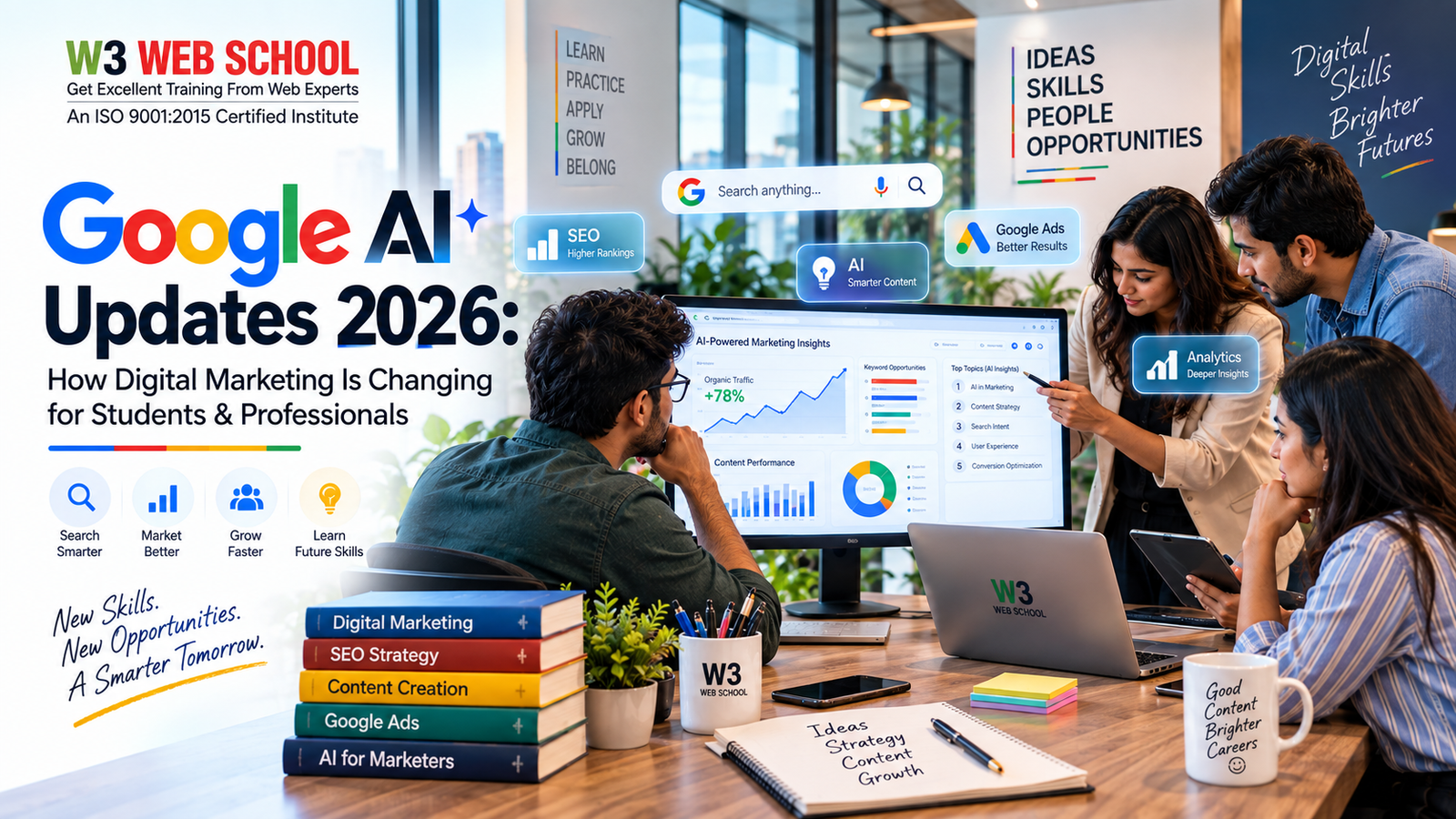
Google AI Updates 2026: How Digital Marketing Is Changing for Students & Professionals

Google's latest AI developments are reshaping SEO, Google Ads, content marketing and search experiences. Here's what students, marketers and businesses need to know in 2026.

W3 Web School Editorial Team
Written by W3 Web School Team
Reviewed by Shaheel & Ankit (Trainers)
Published: Sep 4, 2026
Updated: Sep 4, 2026
⏱️ 8–10 Min Read
Link copied to clipboard!

Google is rapidly expanding the use of artificial intelligence across Search, advertising and productivity tools, making AI a fundamental part of how digital marketing works in 2026. Recent announcements and product updates indicate that AI is no longer limited to content generation—it now influences how users discover information, how businesses reach customers and how marketers measure campaign performance.

For SEO professionals, the growing role of AI means creating genuinely helpful, experience-driven content has become more important than simply targeting keywords. In paid advertising, automation and AI-assisted campaign optimization continue to reduce manual work while increasing the importance of strategic decision-making.

What Did Google Announce in Its Latest AI Updates?

Google has continued expanding artificial intelligence across its products in 2026, making AI an integral part of Search, advertising, education and business productivity. Instead of introducing AI as a separate feature, the company is increasingly embedding it into everyday digital experiences, allowing users to search, create content and complete tasks more efficiently. These updates indicate Google's long-term strategy of making AI a core component of its ecosystem rather than an optional add-on.

One of the most significant developments is the continued evolution of AI-powered Search, where users receive richer, more contextual responses for complex queries. This encourages marketers to focus on creating content that demonstrates real expertise, answers user questions clearly and provides genuine value instead of relying solely on keyword optimization. As search behaviour evolves, websites with helpful, well-structured and trustworthy content are likely to remain more competitive.

Google has also enhanced its AI capabilities across advertising platforms, helping businesses automate campaign management, audience targeting and performance optimization. While automation is reducing repetitive manual work, successful campaigns still depend on strong strategy, creative messaging and accurate business goals. AI can improve efficiency, but it cannot replace marketing fundamentals such as understanding customer intent and building effective campaigns.

For students and professionals, these updates represent an important shift in the skills required by the industry. Employers are increasingly looking for marketers who understand how to work alongside AI tools while maintaining critical thinking, creativity and analytical decision-making. Learning how AI supports SEO, Google Ads, analytics and content workflows is becoming just as important as understanding the platforms themselves.

Overall, Google's latest AI initiatives reinforce one clear message: artificial intelligence is changing how digital marketing is executed, but human expertise continues to determine how effectively those tools are used.

📌 Quick Highlights
  • AI is becoming a core part of Google Search and digital marketing workflows.
  • Search is placing greater emphasis on helpful, experience-based content.
  • AI-powered advertising features are simplifying campaign optimization.
  • Marketers are expected to combine AI efficiency with strategic thinking.
  • Students should start learning AI-assisted SEO, content marketing and advertising to stay industry-ready.

Why These Google AI Updates Matter for Digital Marketing

Artificial intelligence is no longer just a productivity tool—it is becoming a fundamental part of how digital marketing strategies are planned, executed and measured. Google's latest AI developments indicate that marketers must now adapt to an environment where automation, user intent and content quality work together. While AI can simplify repetitive tasks, businesses still need human expertise to build trust, solve customer problems and create meaningful digital experiences.

For SEO professionals, the biggest change is the increasing importance of producing content that demonstrates real experience and expertise. Simply publishing keyword-focused articles is no longer enough. Google continues to reward content that answers user questions clearly, provides practical insights and delivers genuine value. This makes research, originality and topical authority more important than ever.

Businesses running Google Ads are also experiencing a shift toward AI-assisted campaign management. Features such as automated bidding, audience optimization and creative recommendations help marketers save time and improve efficiency. However, successful advertising still depends on defining clear business goals, understanding customer behaviour and continuously analysing campaign performance rather than relying entirely on automation.

Content marketing is evolving in a similar way. AI tools can assist with research, content planning and first drafts, but they cannot replace authentic industry knowledge, personal experience or strategic storytelling. Readers continue to prefer content that is accurate, practical and written for humans rather than content produced solely through automation.

These changes are also influencing hiring trends. Companies are increasingly looking for professionals who understand both traditional digital marketing principles and modern AI-powered workflows. Skills such as SEO, Google Ads, analytics, content strategy and AI-assisted marketing are becoming essential for students preparing for careers in digital marketing.

Rather than replacing marketers, Google's AI advancements are changing the way professionals work. Those who combine technical knowledge with creativity, analytical thinking and responsible AI usage will be better positioned to succeed in the rapidly evolving digital landscape.

📊 How AI Is Influencing Different Areas of Digital Marketing

Digital Marketing AreaImpact of Google's AI Updates
SEOGreater focus on helpful, experience-driven content and user intent
Google AdsIncreased automation for bidding, targeting and campaign optimization
Content MarketingFaster research and drafting while maintaining originality and quality
AnalyticsImproved data interpretation and performance insights
Social MediaBetter content planning and audience analysis using AI tools
Career OpportunitiesHigher demand for professionals with AI-assisted digital marketing skills
💬 Expert Insight

AI is changing how marketers work—not why they work. Strategy, creativity, ethical decision-making and understanding customer needs remain the most valuable skills. Professionals who learn to use AI as a productivity partner, rather than a replacement for expertise, will have a stronger competitive advantage in the coming years.

How Google's AI Updates Are Changing SEO in 2026

Search engine optimization has entered a new phase where success depends less on publishing large volumes of content and more on delivering information that genuinely helps users. Google's latest AI advancements are changing how search results are generated, interpreted and presented, encouraging website owners to focus on expertise, relevance and user satisfaction instead of traditional ranking tactics.

One of the most noticeable changes is the growing importance of search intent. Rather than matching keywords alone, Google is becoming better at understanding what users are actually trying to achieve. Whether someone wants to learn, compare products or make a purchase, search results increasingly prioritize content that provides the most useful and complete answer.

This shift also places greater emphasis on Experience, Expertise, Authoritativeness and Trust (EEAT). Websites that demonstrate real-world knowledge, transparent authorship and accurate information are more likely to build long-term visibility. Content created solely to target search engines without adding meaningful value may struggle to perform as Google's AI continues improving its understanding of quality.

Another important trend is the increasing need for topical authority. Instead of relying on a single well-optimized page, businesses are seeing better results by publishing interconnected content that thoroughly covers a subject. Building comprehensive content clusters helps search engines understand expertise while making it easier for users to find relevant information.

AI tools are also changing how SEO professionals work behind the scenes. Keyword research, content briefs, technical audits and competitor analysis can now be completed more efficiently with AI assistance. However, experienced marketers continue to review, refine and validate AI-generated suggestions before publishing because search performance still depends on accuracy, originality and user experience.

For businesses and aspiring SEO professionals, the message is clear: AI can accelerate SEO workflows, but sustainable rankings still come from publishing trustworthy, helpful and experience-driven content that genuinely solves user problems.

SEO Priorities in the AI Era

Traditional SEO ApproachModern AI-Driven SEO Approach
Focus on exact-match keywordsFocus on user intent and topic relevance
Publish more contentPublish more valuable content
Basic keyword optimizationComprehensive topical authority
Manual research onlyAI-assisted research with human validation
Ranking-focused writingUser-first, experience-driven content
Individual pagesConnected content clusters
Expert Insight

Many marketers believe AI will replace SEO, but the reality is different. AI is changing how SEO is performed, not eliminating the need for it. Businesses that combine AI-powered efficiency with original expertise, technical optimization and helpful content are likely to build stronger long-term organic visibility than those relying entirely on automation.

How Google's AI Updates Are Changing Google Ads and Performance Marketing

Artificial intelligence is becoming a core part of Google Ads, changing the way businesses create, manage and optimize advertising campaigns. Many tasks that once required manual effort—such as bidding, audience targeting and performance optimization—are now increasingly supported by AI. This allows marketers to spend less time on repetitive campaign management and more time focusing on strategy, creative messaging and business growth.

One of the biggest advantages of AI-powered advertising is its ability to process large amounts of data in real time. Instead of relying only on historical performance, AI can identify patterns, predict user behaviour and recommend adjustments that help improve campaign efficiency. As a result, businesses can often reach more relevant audiences while making better use of their advertising budgets.

However, automation does not eliminate the need for skilled marketers. AI can recommend bidding strategies or audience segments, but it cannot fully understand a company's unique goals, brand voice or customer expectations. Successful campaigns still require professionals who can write persuasive ad copy, create compelling landing pages, analyse conversion data and make informed marketing decisions.

For students preparing for careers in performance marketing, understanding AI-assisted advertising is becoming an essential skill. Learning how Google's automation works, when to trust AI recommendations and when to apply human judgement will help marketers deliver stronger campaign results in an increasingly competitive digital landscape.

Ultimately, AI is making Google Ads more efficient, but long-term success still depends on combining automation with strategic thinking, continuous testing and a deep understanding of customer intent.

📊 Traditional Google Ads vs AI-Assisted Google Ads

Traditional Campaign ManagementAI-Assisted Campaign Management
Manual bidding adjustmentsAutomated smart bidding
Broad audience targetingAI-powered audience optimization
Manual budget allocationReal-time budget recommendations
Individual ad testingAI-assisted creative optimization
Manual performance analysisPredictive insights and recommendations
Time-consuming optimizationFaster, data-driven campaign improvements
Expert Insight

The most successful performance marketers in 2026 won't be those who rely entirely on AI or avoid it completely. They'll be the professionals who understand how to combine Google's AI-powered automation with strong marketing strategy, creative thinking and continuous performance analysis.

📌 Key Takeaways

  • AI is simplifying campaign management and optimization.
  • Smart bidding and audience targeting are becoming standard features.
  • Human strategy remains essential for campaign success.
  • Understanding data and customer intent is still more valuable than relying only on automation.
  • Students should learn both Google Ads fundamentals and AI-assisted campaign management to stay industry-ready.

How AI Is Changing Content Marketing in 2026

Content marketing is evolving rapidly as artificial intelligence becomes part of everyday marketing workflows. From generating topic ideas to organizing content calendars and analysing audience behaviour, AI is helping marketers work faster than ever before. However, Google's latest AI developments make one thing clear: speed alone does not create valuable content. Quality, originality and user experience remain the foundation of successful content marketing.

Many businesses now use AI to assist with keyword research, headline suggestions, content outlines and first drafts. These tools can reduce the time required for research and planning, allowing marketers to focus more on refining ideas and creating content that genuinely helps readers. Rather than replacing human creativity, AI is becoming a productivity assistant that supports the content creation process.

At the same time, Google continues to prioritise content that demonstrates real experience, practical insights and trustworthy information. Articles written only to manipulate search rankings or generated without meaningful human review may struggle to build long-term visibility. Readers are also becoming more selective, preferring content that answers real questions, includes examples and reflects genuine expertise.

This shift means that successful content marketers must combine AI efficiency with strong editorial judgment. Every article should be fact-checked, updated regularly and written with the reader's needs in mind. Businesses that invest in helpful, experience-driven content are more likely to build trust, increase organic visibility and strengthen their brand over time.

For students entering digital marketing, learning how to use AI responsibly is now an essential skill. Understanding when AI can assist with research, when human creativity is required and how to maintain originality will become increasingly valuable as the industry continues to evolve.

📊 AI's Role Across the Content Marketing Workflow

Content Marketing TaskHow AI Can HelpHuman Responsibility
Topic ResearchDiscover trends and content ideasSelect topics relevant to the audience
Keyword ResearchIdentify search opportunitiesUnderstand search intent and priorities
Content OutlineGenerate structured outlinesImprove flow and depth
Draft CreationProduce first drafts quicklyRewrite, personalise and fact-check
SEO OptimisationSuggest headings and keywordsMaintain readability and originality
Content UpdatesIdentify outdated informationAdd expert insights and current context
Expert Insight

AI should improve the content creation process, not replace the content creator. The articles that perform best are those that combine accurate information, practical experience and human insight with AI-assisted efficiency. As Google's search systems continue evolving, authenticity and usefulness will remain stronger ranking signals than automation alone.

📌 Key Takeaways
  • AI speeds up research and content planning.
  • Human expertise is essential for accuracy and originality.
  • Helpful, experience-based content remains Google's priority.
  • Regular content updates improve long-term relevance.
  • The best results come from combining AI tools with professional editorial review.

Essential AI Skills Every Digital Marketer Should Learn in 2026

As Google continues integrating artificial intelligence into its products, the skills expected from digital marketing professionals are also evolving. While core marketing principles such as understanding customer behaviour, communication and strategy remain essential, AI is changing how these skills are applied in day-to-day work. Professionals who learn to combine marketing expertise with AI-powered tools will be better prepared for the future workplace.

The good news is that businesses are not looking for marketers who can simply use AI tools. They are looking for professionals who understand marketing fundamentals and know how to use AI to improve productivity, decision-making and campaign performance. This means students should focus on building practical skills rather than depending entirely on automation.

SEO professionals should learn how AI can support keyword research, technical audits and content optimization while still understanding search intent and Google's quality guidelines. Performance marketers need to understand AI-assisted bidding, audience segmentation and campaign optimization without losing control over business objectives and conversion strategies.

Content marketers should also become familiar with AI-powered research, planning and editing tools, but continue developing strong writing, storytelling and editing skills. Businesses still value original ideas, creative thinking and content that connects with real people.

Another increasingly valuable skill is data interpretation. AI can generate reports and identify trends, but marketers who understand analytics and can convert data into actionable business decisions will continue to stand out in the job market.

Ultimately, the future belongs to professionals who treat AI as a productivity partner rather than a replacement for critical thinking. Combining technical knowledge, creativity and responsible AI usage will help marketers remain competitive as digital marketing continues to evolve.

📊 Most Valuable Digital Marketing Skills in the AI Era

SkillWhy It Matters in 2026
Search Engine Optimization (SEO)Essential for organic visibility and AI-powered search experiences
Google Ads & Performance MarketingRequired for managing AI-assisted advertising campaigns
Content MarketingHelps create helpful, original and user-focused content
Google Analytics 4 (GA4)Enables better understanding of user behaviour and campaign performance
AI Tools & Prompt WritingImproves productivity and marketing workflows
Marketing StrategyEnsures AI supports real business objectives rather than replacing decision-making
Data AnalysisConverts insights into practical marketing improvements
Communication & CreativityBuilds stronger campaigns, content and customer engagement
Expert Insight

AI tools are becoming easier to use every year, which means technical access is no longer a competitive advantage. The professionals who will grow fastest are those who understand marketing strategy, customer psychology, analytics and business goals, then use AI to execute their ideas more efficiently.

📌 Key Takeaways
  • Learn marketing fundamentals before relying on AI tools.
  • Build practical experience with SEO, Google Ads and analytics.
  • Develop strong writing, communication and problem-solving skills.
  • Use AI to improve productivity—not to replace originality.
  • Continuous learning will become one of the most valuable career skills in digital marketing.

What Should Students and Digital Marketers Do Next?

Artificial intelligence is transforming digital marketing at a rapid pace, but there is no need to learn everything at once. The most effective approach is to build a strong foundation in digital marketing fundamentals while gradually understanding how AI can improve everyday workflows. Professionals who adapt step by step are more likely to succeed than those who depend entirely on automation.

For students planning a career in digital marketing, this is an excellent time to focus on practical learning. Building real projects, understanding search engine optimization, running Google Ads campaigns, analysing website performance and creating content for different platforms remain valuable skills. AI can make these tasks more efficient, but employers continue to look for candidates who can solve problems, think strategically and deliver measurable results.

Working professionals should also treat AI as an opportunity to improve productivity rather than a replacement for their expertise. Learning new AI-powered features, experimenting with different tools and continuously updating digital marketing knowledge can help professionals stay relevant as the industry evolves. At the same time, maintaining ethical marketing practices, verifying information and creating original content remain essential for building long-term credibility.

Businesses should encourage their marketing teams to develop both technical and strategic skills. Investing in continuous learning, adopting AI responsibly and keeping customer needs at the centre of every campaign will create stronger long-term results than relying on automation alone.

The future of digital marketing will belong to professionals who combine human creativity, analytical thinking and AI-powered efficiency. Those who continue learning and adapting will be better prepared for the next generation of search, advertising and content marketing.

Practical Action Plan

If You Are...Start Doing This Today
StudentLearn SEO, Google Ads, GA4 and AI tools through practical projects.
Job SeekerBuild a portfolio that showcases real campaigns, content and analytics work.
FreelancerUse AI to improve productivity while maintaining originality and quality.
Business OwnerIntegrate AI into marketing workflows without compromising customer experience.
Marketing ProfessionalStay updated with Google's latest AI features and continuously upgrade your skills.
Expert Perspective

Digital marketing has always evolved with new technologies—from social media and mobile marketing to automation and analytics. AI is simply the next stage of that evolution. Professionals who continue learning, experimenting and focusing on delivering value to users will remain competitive regardless of how technology changes.

📌 Key Takeaways
  • Focus on mastering marketing fundamentals before depending on AI.
  • Build practical experience through real-world projects.
  • Use AI to improve efficiency, not replace expertise.
  • Stay informed about Google's latest updates and industry trends.
  • Continuous learning is the strongest long-term career advantage.

Expert Analysis: The Future of Digital Marketing in the AI Era

Artificial intelligence is undoubtedly changing the digital marketing industry, but its role should be viewed as an accelerator rather than a replacement for human expertise. Google's latest AI developments demonstrate that technology is making marketing processes faster and more data-driven, yet the principles of successful marketing remain unchanged. Businesses still need to understand their audience, create meaningful experiences and build trust through valuable content.

One of the biggest misconceptions surrounding AI is that it will eliminate the need for digital marketers. In reality, the demand is shifting toward professionals who can combine technical knowledge with strategic thinking. AI can assist with research, automation and performance optimization, but it cannot replace creativity, business understanding or ethical decision-making. These qualities continue to differentiate successful marketers from those who rely solely on automation.

For educational institutions and training providers, these developments also highlight the importance of updating learning methodologies. Digital marketing education should now include practical experience with AI-assisted workflows while maintaining a strong focus on SEO, Google Ads, analytics, content strategy and user-centric marketing principles. Students who develop both technical proficiency and critical thinking skills will be better prepared for future career opportunities.

Businesses should also approach AI with a long-term perspective. Rather than adopting every new tool immediately, organisations should evaluate whether a technology genuinely improves customer experience, marketing efficiency and business outcomes. Responsible AI adoption, supported by continuous learning and human oversight, is likely to deliver more sustainable results than relying entirely on automation.

Looking ahead, AI will continue to influence search, advertising, analytics and content creation. However, the marketers who achieve long-term success will be those who understand how to use these technologies to enhance human expertise rather than replace it. Adaptability, continuous learning and a commitment to creating helpful, trustworthy content will remain the strongest competitive advantages in the years ahead.

📌 Key Takeaways
  • AI is transforming digital marketing, but human expertise remains essential.
  • Google's updates encourage marketers to focus on quality, relevance and user experience.
  • AI should be used to improve productivity, not replace strategic thinking.
  • Businesses that combine technology with authentic customer value are more likely to achieve sustainable growth.
  • Continuous learning will remain the most valuable investment for students and marketing professionals.
Final Thought

Digital marketing has evolved through search engines, social media, mobile-first experiences and data-driven marketing. Artificial intelligence represents the next major phase of this evolution. While tools and technologies will continue to change, the ability to understand people, solve problems and create meaningful digital experiences will always remain at the heart of successful marketing.

Frequently Asked Questions (FAQs)

1. What are Google's latest AI updates in 2026?
Google has continued expanding artificial intelligence across Search, Google Ads and other digital products to improve how users find information and how businesses manage marketing campaigns. These updates focus on delivering more relevant search experiences, smarter advertising automation and improved productivity through AI-assisted workflows.
2. Will AI replace digital marketers?
No. AI is changing how marketers work, but it is not replacing the need for human expertise. Successful digital marketers still need strategic thinking, creativity, communication skills, data analysis and a deep understanding of customer behaviour. AI works best as a productivity tool rather than a complete replacement for marketing professionals.
3. How is Google AI changing SEO?
Google's AI systems are placing greater emphasis on helpful, experience-driven content that satisfies user intent. Websites that provide accurate information, demonstrate expertise and create valuable user experiences are more likely to achieve sustainable organic visibility than those relying only on keyword optimization.
4. What digital marketing skills should students learn in 2026?
Students should focus on learning SEO, Google Ads, Google Analytics 4 (GA4), content marketing, social media marketing, AI-powered marketing tools and digital marketing strategy. Developing practical experience through real-world projects is equally important for career growth.
5. Can AI create high-ranking SEO content on its own?
AI can assist with research, outlines and first drafts, but high-quality SEO content still requires human review, fact-checking, originality and practical insights. Google's focus remains on publishing helpful content that demonstrates expertise and provides real value to readers.
6. How can businesses use AI in digital marketing?
Businesses can use AI to improve keyword research, automate advertising campaigns, analyse customer data, optimize content workflows and enhance marketing efficiency. However, AI should support business strategy rather than replace human decision-making.
7. Is learning AI important for digital marketing careers?
Yes. Understanding AI-powered marketing tools is becoming increasingly valuable because many businesses now integrate AI into SEO, advertising, analytics and content creation. Professionals who combine AI knowledge with strong marketing fundamentals are likely to have better career opportunities.
8. What is the future of digital marketing with AI?
The future of digital marketing will combine artificial intelligence with human expertise. AI will continue improving automation and productivity, while marketers will focus on strategy, creativity, customer experience and ethical marketing practices to achieve long-term success.

Conclusion

Artificial intelligence is redefining digital marketing, but it is not changing the core objective of marketing—understanding people and delivering value. Google's latest AI developments show that automation, machine learning and intelligent search experiences will continue shaping SEO, advertising and content marketing in the coming years. At the same time, businesses and professionals who prioritise expertise, originality and user-focused strategies will remain in the strongest position.

For students, this is an opportunity to prepare for a rapidly evolving industry by learning both traditional digital marketing concepts and modern AI-assisted workflows. For businesses, it is a reminder that technology should strengthen customer experiences rather than replace thoughtful marketing decisions.

As Google's AI ecosystem continues to evolve, staying informed, continuously upgrading your skills and applying AI responsibly will be the key to long-term success. The future of digital marketing belongs to professionals who combine innovation with human expertise—not to those who rely on automation alone.

🚀 Continue Learning

If you're planning to build a career in digital marketing or want practical experience with SEO, Google Ads, Meta Ads, Google Analytics 4, AI-powered marketing tools and live projects, structured training can help you apply these concepts in real-world scenarios.

Explore W3 Web School's Digital Marketing Course in Kolkata to gain hands-on experience, industry mentorship and practical exposure to the latest AI-driven digital marketing practices.

Students learning in a Digital Marketing Course classroom in Kolkata

📚 Sources & References

This article is based on recent Google announcements, official product updates and publicly available industry resources.

Note: All insights and recommendations shared in this article represent the independent editorial analysis of the editorial team based on publicly available information and industry best practices.

W3 Web School Editorial Team

About the Author

W3 Web School Editorial Team

The W3 Web School Editorial Team consists of experienced digital marketing trainers, SEO specialists, and content strategists who regularly publish practical guides, industry updates, and educational resources. Every article is reviewed to ensure accuracy, relevance, and compliance with current digital marketing best practices.

Areas of Expertise
Search Engine Optimization (SEO) Google Ads Performance Marketing AI in Digital Marketing Content Marketing Google Analytics 4
🔄 Last Reviewed: September 4, 2026
The content is updated regularly to reflect the latest Google AI developments, search updates, and digital marketing trends.
Article Tags
Google AI Artificial Intelligence SEO Google Search Google Ads Content Marketing Digital Marketing AI Marketing Google Updates Digital Marketing News