Full Stack Developer Course Syllabus 2026: Duration, Fees & Careers

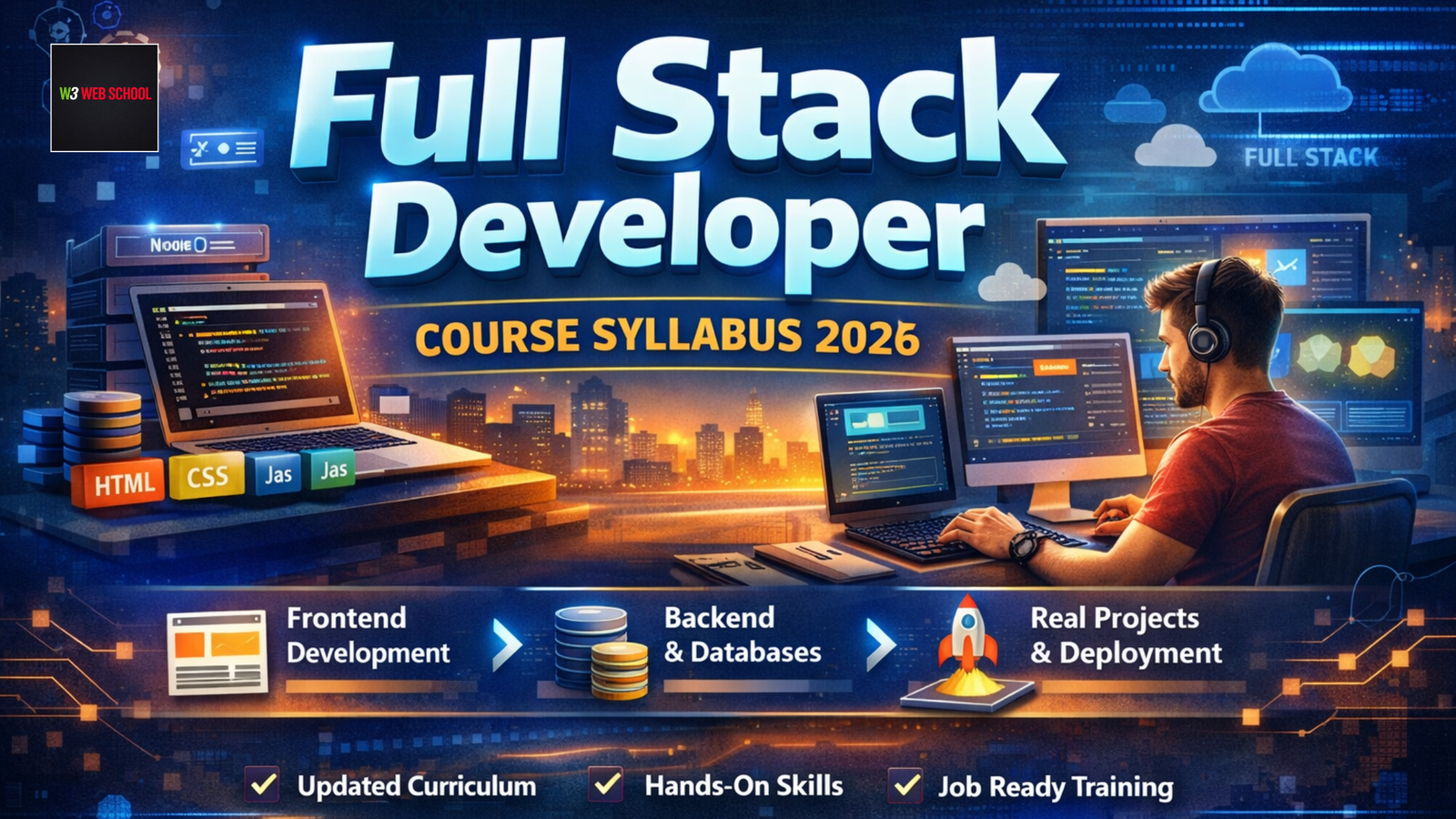
Full-stack developers are in huge demand in this booming field of programming. Mastering this advanced technology will get you multiple career opportunities. Do you want to know what an updated Full Stack Developer Course Syllabus Cover? Wondering whether it is right for you!
With web development skills, talented individuals are able to handle both frontend and backend web development tasks.
According to MarketUsScoop, the web development market is projected to grow by a 6.3% CAGR, and is expected to reach USD 101.54B by 2034. The growth of the Web Development freelance market will witness a rise from $7.29 trillion to $24.78 trillion over the next 5 to 7 years, highlighting rapid market growth.
This is the perfect time if you’re looking to enter into full-stack development as your professional career. This guide will discuss what Full-stack development is, review the details of a Full Stack developer course syllabus, and cover job roles, key responsibilities, and salaries.
What is full-stack development?
In the IT sector, the term ‘Full-stack development’ is becoming highly popular. According to statistics, there has been a rise of 35% in demand for full-stack developers since 2015. Using both frontend and back-end development techniques for website creation is known as full-stack development.
This covers server administration, database management, and UI/UX. Let’s explore the detailed Full Stack Developer Course Syllabus of W3 Web School, which is specially designed for people who want to gain expertise in frontend and back-end web development technologies.
Must have skills for full-stack developers
There are plenty of diverse skill sets one must possess to become a full-stack developer, and those are:
Frontend web development skills
- Master the software such as HTML, JavaScript, and CSS.
- Manage the framework, including Angular and ReactJS.
- Responsive and adaptive web design
Back-end web development skills
- Able to do API integration and design
- Master server-side languages such as PHP, Python, and Node.js
- Able to manage databases such as MySQL, SQL, MongoDB, and NoSQL
- Using and managing servers
Database management skills
- Able to understand data modeling and databases, which are extremely important in developing applications that are scalable and efficient.
- A web developer must have an understanding of web architecture and how the components of the web interact with each other.
Full-Stack Developer Course at W3 Web School, Kolkata
W3 Web School is popular and reputed for its thorough and industry-specific full-stack web development course. They also offer a comprehensive and especially crafted full stack developer course syllabus that comprises every aspect of full-stack web development.
We have demonstrated a detailed full-stack web development course syllabus below.
Detailed Full-Stack Developer Course Syllabus
The detailed full-stack developer course syllabus has covered three major sections, including frontend, back-end, and databases, which are thoroughly discussed below.
| Module | Topics Covered |
|---|---|
| Module 1 | Fundamentals of Software Development |
| Module 2 | HTML |
| Module 3 | CSS |
| Module 4 | JavaScript Fundamentals |
| Module 5 | Frontend Frameworks (React JS, jQuery) |
| Module 6 | Responsive Web Design |
| Module 7 | WordPress Core |
| Module 8 | Elementor Page Builder |
| Module 9 | WooCommerce E-Commerce |
| Module 10 | Introduction to Server-Side Programming |
| Module 11 | Server-side Frameworks |
| Module 12 | APIs |
| Module 13 | Authentication and Authorization |
| Module 14 | Introduction to Databases |
Download the 2026 Updated Full Stack Development Course Syllabus PDF and explore complete modules, tools, and strategies. Plan your learning with clarity and confidence.
Frontend Syllabus
The front end, commonly known as the client’s side, plays a significant role in attracting and engaging the audience. It is the part that the audience views and interacts with while browsing a website.
JavaScript, HTML, and CSS are major languages that help in creating buttons, graphics, and the layout of a website to make it look more engaging and captivating. This helps in making a website user-friendly and user-interactive in daily life.
Module 1: Fundamentals of Software Development
You will learn the basics of a software development system in this full-stack developer course syllabus. Start with learning core concepts such as algorithms, different data structures, and Software Development Life Cycle (SDLC), and more!
These core concepts will set the foundation for making practical problem-solving skills, which are highly praised in full-developer job roles.
Contents
- Concepts of Software Development
- Introduction to the Software Development Life Cycle (SDLC)
- Overview of Algorithms
- Fundamentals of Data Structure
Module 2: HTML
HTML is the next module of the full stack developer course syllabus. This backbone of the webpage helps you explore the elements, structure, and tags, so that you can make an interactive, well-structured, and easily accessible webpage.
Contents
- HTML structure
- Tags and elements
- HTML vs. HTML 5
- Semantic tags and markup
- Hyperlinks and navigation
- Syntax and inputs
Module 3: CSS
CSS is another popular module in a full stack developer course syllabus that helps you master fonts, animations, style layouts, and colors. Here you will learn how to make websites visually attractive and fully responsive for all devices.
Contents
- CSS selectors and syntax
- Box Model
- Positioning and layout
- Animations, transforms, and transitions
- Lists and navigation menus
- Styling tables
- Fonts, size, color, and styling of texts
- Background, shadows, and border
- Multi-column layouts
- Media queries
Module 4: Java Script Fundamentals
The next module in a full stack developer course syllabus is JavaScript, and this helps you make highly interactive websites.
Here, you will learn about different types of loops, variables, arrays, and functions to make user-intuitive, and dynamic web pages for higher engagement.
Contents
- Overview of JavaScript
- Data types and variables
- Test and debug a JavaScript
- Creating and using an array
- Scopes and functions
- Operators
- Loops
- Inputs and display outputs
Module 5: Frontend Frameworks (React JS, jQuery)
Frameworks in the full-stack development courses make development simpler. This module trains you how to deal with states, make robust designs, reusable components, and use modern technologies to make highly interactive webpages with React.js and jQuery.
Contents
- Introduction to React.js
- Create a React app.
- Pure Components
- Lifecycle Methods
- Environment Set Up
- Using consumers and providers
- Concepts of React Hooks and React Forms
- React Router DOM
- Basics of jQuery
- DOM and element manipulation
- Using jQuery effects and UI
- Drag-and-drop interactions
- Buttons and collapsible blocks
Module 6: Responsive Web Design
Users browse on different devices these days. By training you in responsive design techniques, you can ensure that your website works seamlessly on multiple devices like tablets, computers, and mobile devices.
Contents
- Overview of Responsive
- Design Mobile’s first design concepts
- Common device dimensions
- Figma to HTML Convert
- Using CSS media queries and the Viewport tag
- Testing and Debugging for Responsiveness
Module 7: WordPress Core
Master wordpress fundamentals along with dashboard navigation, widgets, plugins, menus, and installation to build and manage a well-structured website.
Contents
- Installation & Dashboard
- Themes, Widgets, Menus
- Page Builders Overview
- Essential Plugins
- User Roles
Module 8: Elementor Page Builder
Learn how to use Elementor to design responsive websites using widgets, sections, columns, custom headers, footers, and templates for quick workflow development.
Contents
- Sections, Columns, Widgets
- Landing Page Design
- Responsive Editing
- Header/Footer Builder
- Template Import/Export
Module 9: WooCommerce E-Commerce
Know how to build and handle digital stores using WooCommerce, including setup, product handling, payments, orders, customisation, shipping, and easy integration with Elementor for fully-functional websites.
Contents
- Installation & Setup
- Adding Products Orders
- Payments, Shipping Basic
- Shop Customization
- Elementor + WooCommerce
Back-end syllabus
The back end, widely known as the server’s side, plays a vital role in data management and computation.
It is the non-visual part that is hidden from the audience and uses computing languages such as Python and Node.js. This helps in managing user accounts and payment procedures in daily life.
Module 10: Introduction to Server-Side Programming
The following important module in the Full Stack developer course syllabus is server-side programming to go over the frontend.
The server architecture, ideas, and protocols that drive the unseen but vital operations of web applications are covered here.
Contents
- Overview of server-side programming
- HTML protocol
- Server Architecture
Module 11: Server-side Frameworks
Server-side frameworks speed up and enhance the quality of development. This module in the Full Stack developer course syllabus offers you practical exposure using frameworks to handle data, server operations, and routing safely.
Contents
- Introduction to Server-side Frameworks
Module 12: APIs
The following important module is APIs which helps in connecting services and applications. Here, you will learn how to build APIs for seamless platform communication, along with how they operate and how safe they are.
Contents
- Overview of APIs
- API Security
- Understanding the Geolocation API
- Understanding storage APIs
- API Design and Documentation
Module 13: Authentication and Authorization
The next important module in the Full Stack developer course syllabus is security through authentication and authorization in web applications. They help you learn how to manage users, safeguard their private data, and make highly secure web systems.
Contents
- Introduction to Authorization and Authentication
- User management
Databases
Databases are a vast library where vital data are stored, arranged, and retrieved as per requirements. Access to the database is given via a web browser.
Module 14: Introduction to Databases
The last module you will master in this Full Stack developer course syllabus is Database. These are used to collect and arrange vital data.
In order to ensure precise data storage and retrieval, this module covers the fundamentals of SQL and NoSQL, database design, and data modeling.
Contents
- Fundamentals of databases
- Types of databases: SQL databases and NoSQL databases
- Data Modeling
- Database design and normalization
- Types of NoSQL Databases
- Data modeling in NoSQL databases
Benefits of a detailed Full Stack Developer Course Syllabus
Entering the full-stack developer career with a detailed full-stack developer course syllabus provides plenty of benefits, which are highlighted below.
- Structured skill development: A thorough Full Stack Developer course syllabus guides you to gain knowledge and form skillsets gradually. Each skill will be added to enhance your expertise and guarantee a solid foundation to become a full-stack developer.
- Continuous learning: The syllabus is specially crafted for constant learning. As you proceed, new elements are unlocked, which keep you engaged and encouraged in your continuous learning journey.
- Industry certification: Completing a full-stack developer course with a comprehensive syllabus often unlocks the door to industry recognition and certifications. These industry certifications reflect your expertise in the field of programming.
- Real-world knowledge: The Full Stack developer course syllabus is designed to offer real-world knowledge. The theoretical concepts will be applied to learn more about the intricacies of the programming world and make this full-stack developer career journey more meaningful.
- Real project-based learning: Live client projects are included in this syllabus, which helps you gain experience with real-world case scenarios and the challenges of industry.
- Vast Career Opportunities: A diverse range of career opportunities is unlocked with the comprehensive Full Stack Developer course syllabus. The various job roles offered are full-stack developer, web developer, frontend developer, and back-end developer.
Full-Stack Developer Course Duration & Fee Structure
The full stack developer course fee usually differs due to the comprehensive course curriculum and course duration.
W3 Web School has been offering two types of full-stack developer courses, and the duration of the courses varies between 6 and 9 months.
The full stack developer course fee ranges between 30,000 and 60,000.
Impact of Full Stack Developer Course Duration
Choosing the right course duration can influence your practical skills, learning journey, and job readiness. Let’s find out how different course durations impact your Full Stack Development journey.
Many institutes deliver courses that are of multiple durations, such as a 6-month Web Development course or a 9-month Full Stack Web Development course.
Short courses are best for learners wanting to master development skills fast to enter today’s tech industry. You will get a basic knowledge of HTML, CSS, and JavaScript with backend fundamentals and basics of MongoDB. Limited hands-on projects are offered with limited advanced tools training. Sometimes, the short-duration course doesn’t even contain ReactJS, and this is a major drawback of this course; it is essential for building advanced UI interfaces.
On the other hand, a long-duration Full Stack Web Development Course delivers a more detailed job-focused training. You will get industry-led Full Stack Web Development training on advanced tools, languages, frameworks, and libraries. You will get the chance to work on real-world projects with placement guidance. Long-term Full Stack Web Development courses make you job-ready.
Check out the comparison below:
| 🚀 Key Factors | ⚡ 6-Month Course | 🔥 9-Month Course (Full Stack) |
|---|---|---|
| 📘 Modules Coverage | Basic to Intermediate | Complete Beginner to Advanced |
| 🛠 Tools & Tech | Limited Tools Exposure | Git, GitHub, Deployment & Industry Tools |
| 💻 Practical Experience | Limited Projects | Live Projects + Portfolio Building |
| 🎯 Job Readiness | Moderate | High |
| 💼 Freelancing Skills | Basic Freelancing Knowledge | Client Handling + Freelancing Setup |
If you are planning to become a full-stack web developer, a short-duration course is not recommended. You need practical exposure, advanced skill sets, and real client project working experience.
W3 Web School’s 9-month Full Stack Web Development course is crafted to make you industry ready with job-ready skills and live client project exposure.
Learn full stack development with real projects and become job-ready.
Check Course →
Career Options After the Full Stack Web Developer Course
The demand for full-stack developers is rapidly increasing nowadays, and the reports from Statista have highlighted that full-stack developers have gained the 2nd position as the most demanding IT roles.
A range of career opportunities is available in the IT field today under the same umbrella of full-stack development.
Let’s explore some of the demanding career options after the full-stack developer course below.
- Full-Stack Developer
- Back-end developer
- Frontend developer
- Web Application developer
- Software developer intern
- PHP professional
- Freelance web developer
Full-Stack Developer Salary in Kolkata
According to Ambitionbox, a Full Stack Developer fresher in Kolkata can get up to ₹1.6 lac to ₹12 Lacs per annum, and it can depend on years of working. The Indeed data also reveals that a Full Stack developer fresher can earn up to 3 lacs to 4 lacs annual package in Kolkata, West Bengal.
FAQs on the Full Stack Developer Course Syllabus
Q. What is in the frontend developer course syllabus?
There are some basic topics that cover the entire frontend developer course syllabus, and those are the fundamentals of web development, an introduction to CSS, javascript, and HTML, responsive web design, frameworks such as React.js and Angular.js, an overview of Git and GitHub, testing, debugging, and frontend security best practices.
Q. What topics are covered in the backend developer course syllabus?
The huge range of topics covered in the backend developers course syllabus includes an overview of server-side programming and server-side frameworks such as Node.js and Python, an introduction to APIs, authentication and authorization, databases, their types, SQL and NoSQL databases, hosting, and deployment.
Q. What are the minimum eligibility criteria for joining the full-stack developer course?
The minimum eligibility criteria for joining a full-stack developer course is 10+2 qualified. For graduate candidates with basic programming knowledge, this full-stack developer course will provide an exceptional opportunity to upgrade and secure their aspiring programming career.
Q. How long is the full-stack course?
Usually, the full stack developer course will take up to 6 to 9 months to complete, according to the course curriculum length and frequency of classes.
Q. Can I learn full-stack development without prior knowledge of coding?
Yes, of course! You can learn Ful Stack development without any previous knowledge of coding. Begin with basic courses that offer the fundamentals of CSS, HTML, and JavaScript. Online course providers such as W3 Web School, Udemy, and Simplilearn offer step-by-step assistance.
Q. Which language is best for full-stack developers?
The best language for a full-stack developer depends on the project and individual preferences. Some popular choices are JavaScript and Python, which are widely used for business solutions. These choices are entirely based on the client project requirements and ease of application.
Final Thoughts,
The Full Stack Developer course syllabus offers interested candidates a detailed road map for mastering the challenging field of web development. Web development is a demanding position for recent graduates wanting to build a name for themselves in the IT sector due to the increasing need for skilled individuals in this area.
The Full Stack Developer Course in Kolkata at W3 Web School unites academic learning with practical-world application. You can get a better understanding of the fundamentals of coding with our basic training. Graduates get expertise in all areas of full-stack development, databases, system design, and programming, which prepares them to develop dynamic web applications as qualified and skilled full-stack developers.